

How Much Power, Space and Time Does a 1 TPD Small Palm Oil Refinery Really Need?
One of the first questions a small-scale investor asks is deceptively simple: how much electricity, how much floor space, and how long until a 1 TPD small palm oil refinery is actually running? This guide answers all three with real configuration figures, so you can size your building, your electrical supply and your project timeline before you request a quotation. Glory Oiltech designs, builds and commissions small palm oil refining lines of exactly this size across Africa and Southeast Asia, supported by an ISO-certified factory and an in-country branch and warehouse in Nigeria - so the figures below come from real build sheets, not rough estimates.
The Short Answer
For a standard 1 TPD (1 ton-per-day) small palm oil refinery, here are the headline numbers:
| What you need | Real figure | Notes |
| Installed power | 26.05 kW (refining unit) | +18.5 kW only if you add the optional 500 kg/h filter-press oil expeller |
| Building footprint | 15 m x 6 m x 6 m (~90 m2 floor) | Holds the refining, bleaching and deodorising kettles plus the heat source, vacuum unit and air compressor |
| Manufacturing lead time | ~90 working days | Equipment build and pre-assembly at the Glory Oiltech factory |
| On-site installation | ~60 days | One engineer on site for installation, commissioning and operator training |
| Per-batch cycle | ~24 hours | Degumming - neutralising - washing - drying - bleaching - deodorising |
| Heating method | Electric heating or thermal-oil (heat-transfer-oil) heating | Two options only; thermal-oil heating is recommended where the local grid is unstable |
The rest of this article unpacks each number, what drives it, and the on-site conditions you should have ready on day one.
1. How Much Power Does a 1 TPD Small Oil Refinery Actually Need?
The installed (connected) load of a 1 TPD palm oil refinery is about 26.05 kW. That figure is the sum of every motor on the skid, not the power drawn at any single moment - the agitators, pumps and vacuum system do not all run at full load simultaneously, so real running consumption is lower.
What the 26 kW is made up of
Vacuum system: ~5.5 kW vacuum water pump (ISW50-40) plus a water/steam ejector (PSB120) that pulls the vacuum needed for bleaching and deodorising.
Air compressor: ~4.0 kW piston type (V-0.6/8) with air receiver, for pneumatic control and filtration.
Hot-oil circulation pumps: 2 x 3.0 kW, circulating heated oil from the heat source to the kettles.
Kettle agitators: ~1.1 kW each on the neutralising, bleaching and deodorising kettles (0-100 r/min).
Feed / product pumps: ~1.5 kW per product or soap-stock pump; ~3.0 kW multi-stage feed-water pump.
Control and instrumentation: panel and sensors draw only a small standby load.
Total installed: 26.05 kW. If you also install the 500 kg/h expeller with integrated filter press, add about 18.5 kW. Size your incoming supply and main breaker around the installed figure with a safety margin.
Two heating options - and which to pick
A 1 TPD small palm oil refinery is heated in one of only two ways: electric heating, or thermal-oil (heat-transfer-oil) heating. There is no coal, fuel-oil or gas-fired boiler in a 1 TPD package.
Electric heating: the simplest start-up - no boiler house and no combustion plant, you simply connect power and water. It is the cheapest way to begin where the grid is stable and power is affordable.
Thermal-oil (heat-transfer-oil) heating: a self-contained heat-transfer-oil unit supplies steady, even heat to the kettles independently of the grid. Glory Oiltech recommends thermal-oil heating for sites where the three-phase supply is weak or unreliable, because the process heat does not depend on a stable electrical feed.
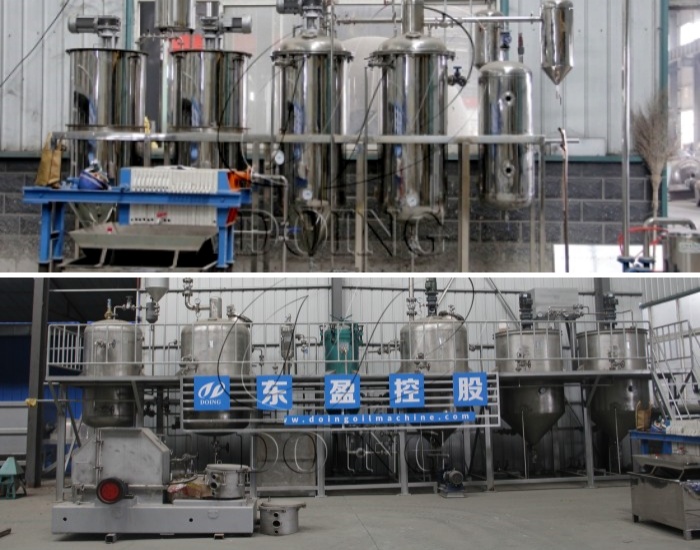 Two heating options of small palm oil refinery
Per-ton utilities to budget (per ton of oil)
| Item | Typical usage |
| Electricity | ~20 kWh / ton oil |
| Water | 120-150 kg / ton oil |
| Bleaching earth | 20-30 kg / ton oil |
| Phosphoric acid | ~0.5 kg / ton oil |
| Caustic soda (NaOH) | 1-3 kg / ton oil (depends on acid value) |
2. How Much Space Does a 1 TPD Palm Oil Refinery Take?
Plan for a 15 m x 6 m x 6 m building (length x width x clear height) - a footprint of roughly 90 square metres. This single covered bay holds the neutralising, bleaching and deodorising kettles on one side and the heat source, vacuum unit and air compressor on the other. The cooling tower and the vacuum pump can be sited outdoors if indoor space is tight.
Small units like this are deliberately designed with a low building-height requirement and a compact layout, which is exactly why a 1 TPD oil refinery fits inside an existing warehouse, an oil workshop or a low-cost new build. It is the same compact, low-headroom philosophy Glory Oiltech applies across its small batch refinery range. When you step up in capacity the building does grow, but not at a fixed rate: for scale, a 10 TPD batch refinery plans for about 24 m x 10 m x 7 m.
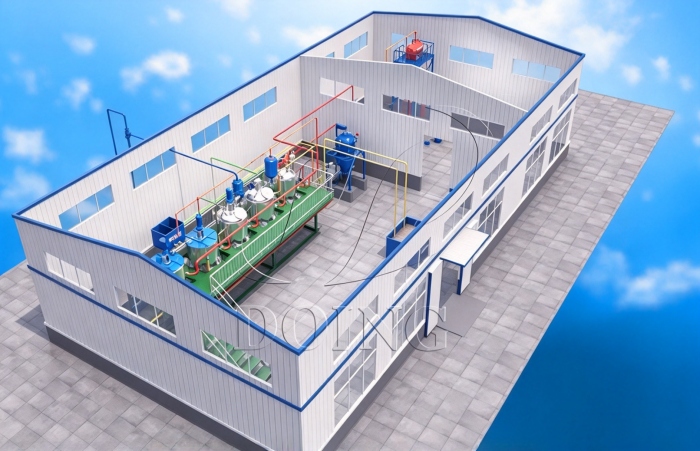 1 TPD small palm oil refinery plant
3. How Long Does Installation Take?
Two separate clocks matter for scheduling: the build time at the factory and the on-site install window.
What site work is your responsibility before the engineer arrives?
Foundations, a crane or hoist to set the kettles, and licensed local welding and electrical work are normally the buyer scope; the Glory Oiltech engineer supervises assembly, commissioning and operator training but does not pour foundations. Having the civil works and a crane ready on day one is what keeps the on-site window close to 60 days.
The two clocks, step by step
1.Manufacturing / pre-assembly: about 90 working days from order, during which most of the assembly and pre-commissioning work is done at the factory.
2.On-site installation: about 60 days, with one engineer on site to supervise installation, commissioning and operator training. The main unit carries a 1-year warranty (excluding wear parts).
3.First production: once commissioned, a full refining batch - degumming, neutralising, washing, drying, bleaching and deodorising - takes about 24 hours, so you can plan on roughly one batch per day at nameplate capacity.
What comparable refining projects show
Nigeria 5 TPD batch palm-oil refinery: signed Mar 2025, delivered Jul 2025, installation started Mar 2026, commissioned and producing about 150 t/month of refined palm oil by 31 Jul 2026.
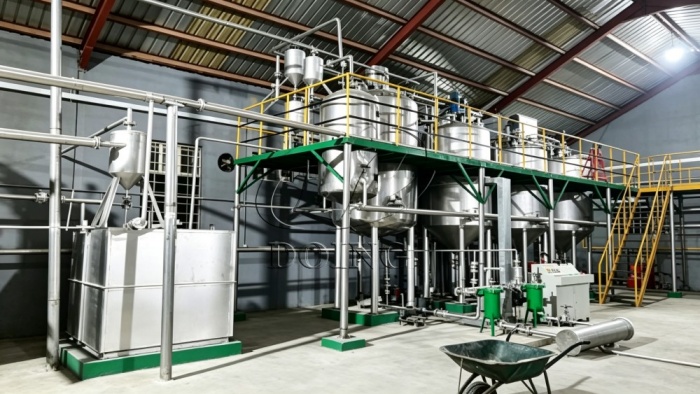 5 TPD batch palm-oil refinery
Indonesia 5 TPD semi-continuous palm-oil refinery: a batch-to-semi-continuous refining line shipped Apr 2018 and installed over roughly Sep-Oct 2018, commissioned Nov 2018 with refined oil meeting the Indonesian standard.
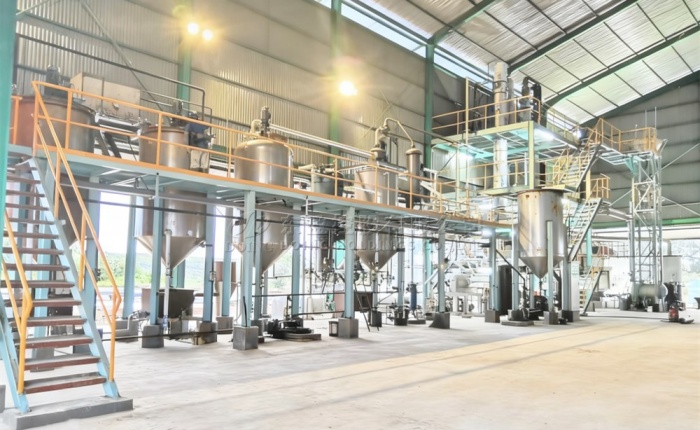
4. What You Need on Site Before Day One (Buyer Checklist)
| On-site condition | Ready when... |
| Power | 3-phase supply sized for ~26 kW installed (add ~18.5 kW if including the expeller) |
| Water | A small water tank (~2 m3) for start-up, plus a circulating cooling pond/tower |
| Heating | Electric heating (needs a stable 3-phase supply) or a thermal-oil heating unit - no coal/gas/oil boiler required for a 1 TPD unit |
| Refining chemicals | Caustic soda, phosphoric acid and bleaching earth, per the per-ton figures above |
| Building | Covered 15 m x 6 m x 6 m bay; cooling tower / vacuum pump may go outdoors |
| Staff | A small crew runs it; the supplier engineer trains your operators during commissioning |
5. When a 1 TPD Small Palm Oil Refinery Is the Right Call
Choose a 1 TPD small palm oil refinery when the following match your situation:
Your throughput is around one ton of oil a day - enough to justify buying rather than toll-refining, but not yet at continuous scale.
You want the lowest realistic capex to start refining, with room to add capacity later.
Your building or land is limited - the compact 15 m x 6 m x 6 m layout and low headroom suit existing sheds.
You process several crude oils - a batch unit lets you alternate palm-kernel, sunflower, rapeseed and soyoil between runs on the same line.
Your grid is unreliable - specify thermal-oil heating so the process does not depend on a stable three-phase supply.
You are a new entrant or a workshop upgrading from selling crude oil to selling refined oil.
If, instead, you are reliably handling large volumes and want lower per-ton utilities, that is the point to consider stepping up to a semi- or fully-continuous line.
Get the Exact Configuration for Your Site
Tell us your crude oil type, daily volume and building dimensions, and Glory Oiltech will confirm the connected load, the heating option (electric or thermal-oil), the building layout and the installation schedule for your 1 TPD small palm oil refinery - with a turnkey package covering manufacturing, shipping, on-site installation, commissioning and operator training.
Frequently Asked Questions About Small Palm Oil Refinery
What if the three-phase power at my site is weak or unreliable?
A 26 kW installed load assumes a stable three-phase supply. Where the grid is weak or prone to voltage dips, size a voltage stabiliser or a diesel generator at roughly 1.3-1.5x the connected load (about 35-40 kVA, nearer 55 kVA if the expeller is included) so motor starting does not stall the line; alternatively switch the heat input to thermal-oil heating.
Can I stack a 1 TPD refinery over two floors to save land?
Yes. The 15 m x 6 m x 6 m single bay is the standard layout, but a batch unit lends itself to a two-level arrangement - kettles up high, heat source and vacuum plant below - which shortens the floor plan where land is costly or the building is narrow. The trade-off is a taller room and lifting access for installation.
Who is responsible for local permits and inspections before the plant can run?
Equipment supply and commissioning do not include site licensing. Building permits, an environmental / emissions approval for the heat source, and electrical-connection approval are normally obtained by the buyer under local rules, while the supplier supports with technical drawings and equipment certifications for the applications. Starting this paperwork in parallel with manufacturing prevents a commissioned line from sitting idle.
If the power cuts out mid-batch, is the oil ruined?
On an electric-heated unit, losing power stops heat input mid-cycle, so the batch should be completed only after supply returns; a thermal-oil unit holds stored heat far longer, which is why grid-prone sites are better served by thermal-oil heating. In both cases the oil is not lost - the cycle is simply extended rather than abandoned.
What quality can a 1 TPD refinery actually achieve?
A properly run batch cycle brings the refined oil to national palm-oil specifications - colour, acid value, moisture and peroxide - with the operator monitoring each step. Glory Oiltech commissioning includes helping you hit the target standard for your market, as on the Indonesian 5 TPD refinery that was signed off against the Indonesian standard.
 PREV:5 Biggest Operating Risks for Small Palm Oil Mills in Nigeria and How to Reduce Them
 NEXT:Palm Kernel Shell Separation Is Poor: 7 Causes and How to Fix It
-
 How to start a palm oil milling and processing plant?
-
How to start a palm oil processing business in nigeria?
-
How to produce refined vegetable oil from palm kernel oil?
-
What are the steps in palm oil production?
-
5 Biggest Operating Risks for Small Palm Oil Mills in Nigeria and How to Reduce Them
-
How Much Power, Space and Time Does a 1 TPD Small Palm Oil Refinery Really Need?
-
Palm Kernel Shell Separation Is Poor: 7 Causes and How to Fix It
-
Batch vs. Continuous Palm Oil Refinery for a 20 TPD Plant in Cameroon: What’s the Difference?