
Palm Kernel Shell Separation Is Poor: 7 Causes and How to Fix It
If your palm kernel shell separation is poor — kernels mixed with shells, low kernel purity, or inconsistent output — you're likely losing quality and money. Poor separation directly impacts palm kernel oil quality because damaged kernels and residual shell fragments introduce impurities and moisture that degrade the final product.
The good news? In most cases, the problem is not the raw material — it's one (or more) of a few well-known, fixable issues. In this guide, Glory Oiltech walks you through 7 common causes of poor palm kernel shell separation and gives you actionable fixes for each one.
Cause 1: Improper Cracker Gap Adjustment
If the gap between the beating rod (rotor) and the teeth of the inner wall is not properly adjusted, palm kernels either crack incompletely or get over-cracked. Both scenarios destroy separation efficiency. Uncracked kernels stay trapped in the shell mass, while over-cracked kernels turn to powder that mixes with shell dust — making it nearly impossible for the separator to produce clean output.
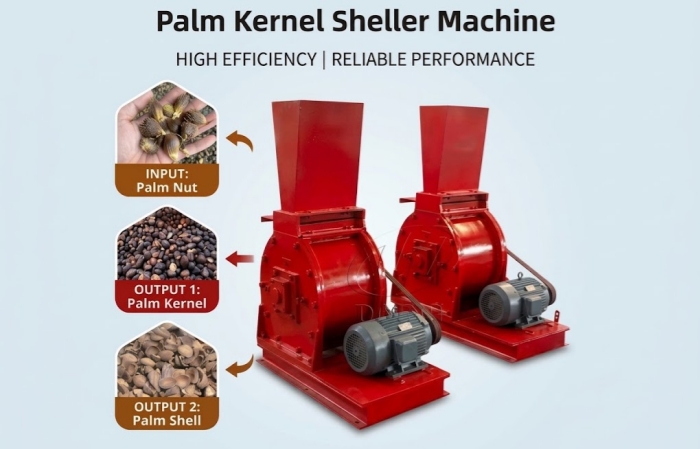 Palm kernel cracker
Fix: Stop the machine, inspect the gap, and adjust it to match the size and hardness of your current palm kernel batch. A proper gap ensures clean cracking with minimal kernel breakage, giving the separator a uniform feed to work with.
Cause 2: High Moisture Content in Palm Kernels
Palm kernels with excessive moisture clump together. When clumped material enters the separator, feeding becomes uneven — some sections are overloaded while others run dry. The result is unstable airflow, poor separation, and inconsistent kernel purity. Overly dry kernels, on the other hand, become brittle and fracture during separation, creating fine dust that contaminates the shell stream.
Fix: Keep palm kernels properly dried before feeding them into the separator. The ideal moisture range allows kernels to flow freely without clumping and without fracturing under impact. Pre-drying is especially important when processing freshly cracked nuts or in humid tropical climates.
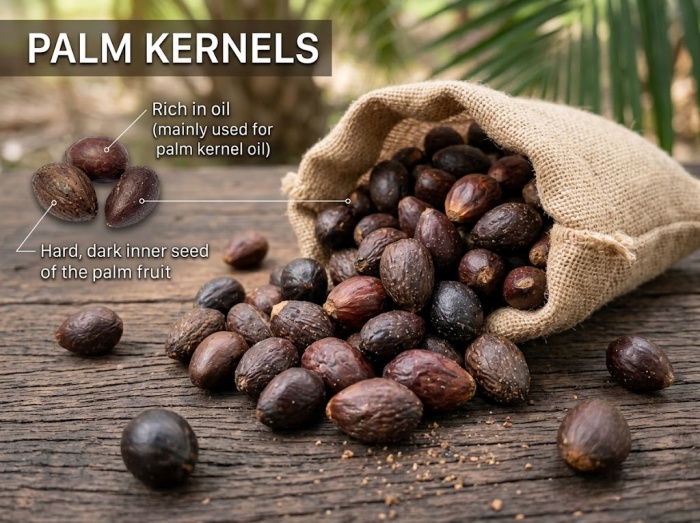 Palm kernels
Cause 3: Inadequate Airflow or Wind Separation Settings
Glory Oiltech's palm kernel shell separator uses a combined gravity-and-air-separation principle. Shells are light enough to be carried by wind power into a spiral motion along the cyclone wall and discharged from the bottom. If the airflow is too weak, shells fall with the kernels. If it's too strong, kernels get swept into the shell outlet. Either way, separation purity drops.
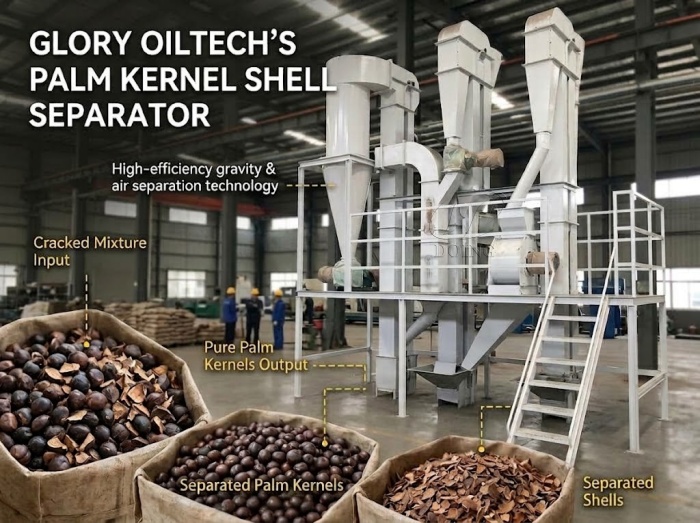 Glory Oiltech's palm kernel shell separator
Fix: Check the fan speed and airflow distribution. Adjust the wind separation column settings until shells are cleanly carried to the cyclone outlet while kernels fall straight down. A well-tuned airflow is the single most important variable for separation efficiency.
Cause 4: Wide Size Distribution of Palm Kernels (No Grading Screen)
When palm kernels vary widely in size, smaller ones pass through the separation zone too quickly while larger ones need more force to be separated. This size mismatch causes uneven separation — small kernels end up in the shell stream, and large kernels remain uncracked or partially cracked.
Fix: Install a palm kernel grading screen before the separator. The grading screen sorts kernels into size batches so that each batch has uniform kernel size. This ensures the cracker and separator work at their optimal settings, significantly improving both cracking rate and separation purity.
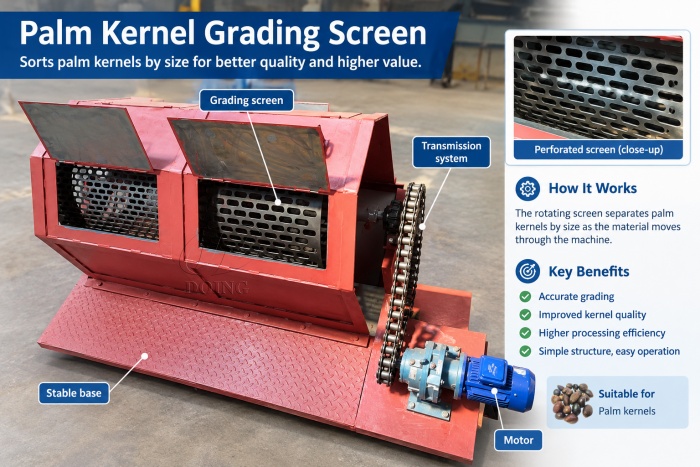 The palm kernel grading screen
Cause 5: Fiber or Foreign Material Contamination
If palm nuts arrive with residual fiber, stones, metal pieces, or other foreign materials, these impurities can clog the separator's channels, damage internal components like blades or sieves, and disrupt the airflow pattern. Even small amounts of fiber can cause chronic blockages that slowly degrade separation performance.
Fix: Ensure fiber is fully removed from palm nuts before cracking. A clean feed stream protects the separator's internal components and maintains consistent airflow for reliable separation.
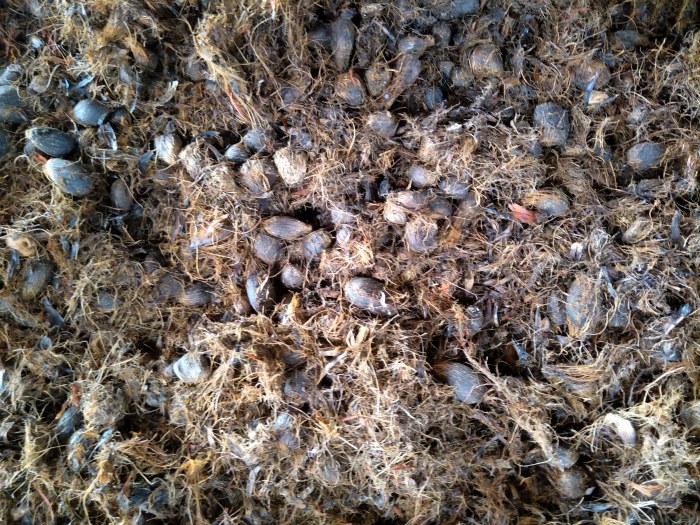 Fibers on the surface of the palm nuts
Cause 6: Worn-Out or Damaged Internal Components
Over time, the blades, sieves, and cyclone parts that directly contact palm kernels and shells experience wear. Dull blades produce more kernel breakage. Warped sieves let oversized material through.
Imbalanced cyclones reduce airflow stability. Any of these issues gradually erode separation efficiency — often so slowly that operators don't notice until purity has already dropped significantly.
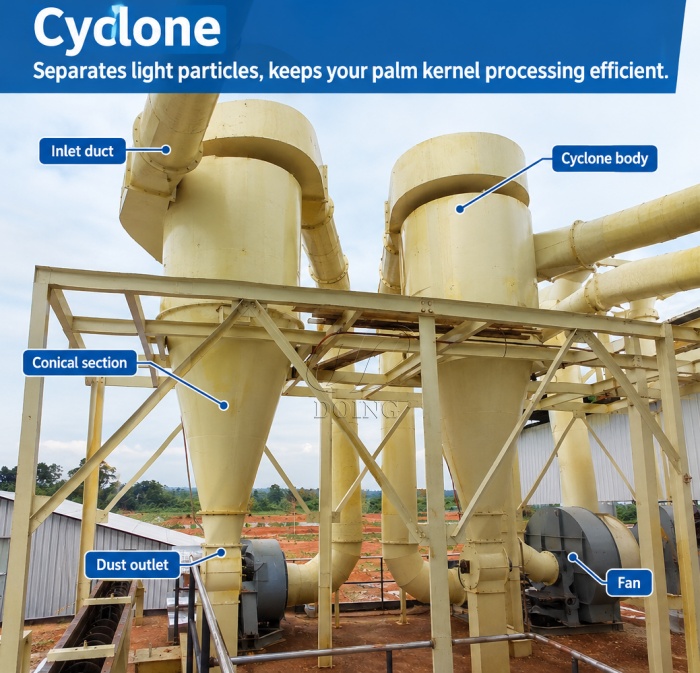 Cyclone
Fix: Include blade, sieve, and cyclone inspection in your regular maintenance schedule. Replace worn parts promptly. High-quality, wear-resistant materials prolong component life and maintain consistent separation performance over many operating cycles.
Cause 7: Uneven or Overfeeding
Feeding too many kernels at once — or feeding them unevenly — overwhelms the separator's capacity. The cracker can't keep up, the airflow gets choked, and the separation zone becomes turbulent. The result is a mix of uncracked kernels, shell-contaminated kernels, and overall instability.
Fix: Adjust the feed rate to a steady, controlled level. Use a conveyor or hopper with a variable-speed feeder to ensure uniform feeding. A consistent feed rate lets the cracker and separator operate at their designed capacity.
When to Consider Upgrading Your Palm Kernel Shell Separation System
If you've checked all seven causes above and your palm kernel shell separation is still poor, the problem may be the equipment itself. Many older or budget separators rely on a single separation method — gravity only or simple screening — which simply cannot handle the challenge of separating palm kernels from shells. Their weights are remarkably similar, making them one of the hardest material pairs to separate in the entire oil processing industry.
Glory Oiltech's automatic palm kernel and shell separating machine solves this problem with a dual-mechanism design: it combines gravity separation and air (wind) separation in one integrated unit. The process works in three stages:
1. Cracking: Palm nuts are cracked to liberate the kernels from the shells.
2. Separation: Kernels fall by gravity while shells are propelled by wind power in a spiral motion along the cyclone wall, discharging from the bottom outlet.
3. Automatic discharge: Kernels drop to the bottom, shells are sucked to the top and drain into the shell outlet — the whole process runs automatically.
This design achieves a separation rate of up to 95%, and when paired with an optional grading screen, it handles variable kernel sizes with consistent results. Glory Oiltech has delivered these systems to customers across Africa and Southeast Asia, including a Ugandan customer who visited the Henan factory, witnessed the running test, and signed the contract on the spot — attracted by the high separation rate and fully automatic operation.
For operators still using the traditional water separation method — pouring water over the kernel-shell mixture and waiting for kernels to settle — the upgrade is even more compelling. Water separation wastes time and manpower, leaves kernels with high moisture content that ruins oil quality, and simply cannot deliver the purity modern processing demands.
Glory Oiltech's ISO-certified factory produces these separators with rigorous quality control, and with a branch office and warehouse in Nigeria, delivery and after-sales support across Africa and Southeast Asia are fast and reliable.
Get a Customized Separation Solution
Poor palm kernel shell separation doesn't have to be your permanent problem. Whether you need to tune up an existing line or start fresh with a new automatic separator, Glory Oiltech provides end-to-end support — from factory testing and running videos to on-site installation and after-sales service. With a branch office and warehouse in Nigeria and delivery experience across Africa and Southeast Asia, we help you get separation right — fast.
Contact Glory Oiltech today for a free consultation and customized solution for your palm kernel oil processing plant.
Can I improve my existing separator's performance without buying a new machine?
Often, yes. Before investing in new equipment, check the seven causes listed above — especially airflow settings and the grading screen. Many operators find that adjusting the fan speed and installing a grading screen boosts their separation rate noticeably. [general guidance - to be confirmed with Glory Oiltech] If your separator is a basic gravity-only model with no cyclone design, upgrading to a gravity-plus-air system (like Glory Oiltech's) will deliver the most dramatic improvement. But don't skip the tuning steps first — a well-tuned basic separator outperforms a poorly tuned premium one.
Does the grading screen really make a difference, or is it optional?
It's optional but highly recommended. Without a grading screen, a mix of large and small kernels enters the cracker at the same time. Small kernels get over-cracked (broken into pieces), while large kernels stay partially uncracked. Both outcomes hurt separation purity. The grading screen sorts kernels by size first, so the cracker and separator each handle a uniform batch — this is especially important when your raw material comes from multiple palm oil mill sources with different pressing or cracking characteristics.
How often should I replace the blades and sieves in the separator?
As a general reference, inspect blades and sieves every 3–6 months of continuous operation, and replace when you notice increased kernel breakage or declining separation purity. [general guidance - to be confirmed with Glory Oiltech] Regular inspection is far cheaper than letting worn parts run until they cause a major quality drop or secondary damage to other components.
What's the real difference between gravity-only and gravity-plus-air separation?
Gravity-only separators rely on weight difference alone — but palm kernel and shell weights are very close, which is why gravity-only systems struggle. Adding an air (wind) separation mechanism uses airflow to carry the lighter shells away in a spiral path while kernels fall straight down by gravity. The dual-mechanism approach is why Glory Oiltech's separator achieves 95% separation rate — a figure that gravity-only systems simply cannot reach consistently. Glory Oiltech's cyclone design propels shells in a spiral motion along the cyclone wall, creating a downward, outward-swirl airflow that discharges shells cleanly from the bottom.
How does poor shell separation affect my downstream palm kernel oil extraction?
Shell contamination in the kernel stream doesn't just lower kernel purity — it also introduces fiber and moisture into the pressing or extraction stage. Fiber absorbs oil that should come from kernels, and moisture promotes mold and free fatty acid (FFA) rise during storage. The net result is lower oil yield, higher FFA, and a darker, lower-grade oil. Good shell separation at the front end is the cheapest insurance for better oil quality at the back end.
 PREV:How Much Power, Space and Time Does a 1 TPD Small Palm Oil Refinery Really Need?
 NEXT:Batch vs. Continuous Palm Oil Refinery for a 20 TPD Plant in Cameroon: What’s the Difference?
-
 How to start a palm oil milling and processing plant?
-
How to start a palm oil processing business in nigeria?
-
How to produce refined vegetable oil from palm kernel oil?
-
What are the steps in palm oil production?
-
5 Biggest Operating Risks for Small Palm Oil Mills in Nigeria and How to Reduce Them
-
How Much Power, Space and Time Does a 1 TPD Small Palm Oil Refinery Really Need?
-
Palm Kernel Shell Separation Is Poor: 7 Causes and How to Fix It
-
Batch vs. Continuous Palm Oil Refinery for a 20 TPD Plant in Cameroon: What’s the Difference?