

What Is the Clarification Station in a Large Palm Oil Mill?
In large palm oil mills, the pressed oil-water-fiber mixture is not qualified as direct-use crude palm oil. As the core section of a large palm oil mill, the clarification station converts this mixture into pure, stable crude palm oil that meets commercial standards, whose process efficiency and operational stability directly dictate the final product quality, oil yield and production efficiency.
Why Clarification Is Necessary?
Freshly pressed crude palm oil contains significant impurities, typically consisting of approximately 60% oil, 24% water and 16% solid contaminants (e.g., mesocarp fibers, sands). Without effective separation, high moisture and impurity content will accelerate oil rancidity and lead to substantial product devaluation.
Main Process Flow and Equipment
The clarification station of a large palm oil mill is mainly divided into three stages: primary impurity removal, core clarification and separation, and sludge oil recovery and treatment.
1. Primary Impurity Removal Stage
The pressed palm oil slurry is first pumped into a sand trap tank, where gravity sedimentation is used to preliminarily separate heavy impurities such as sand particles. Subsequently, the oil mixture is fed into a vibrating screen, which effectively filters out most coarse fibers and solid particles. The oil-bearing coarse residues trapped on the screen are recycled for reprocessing to boost the overall oil yield.
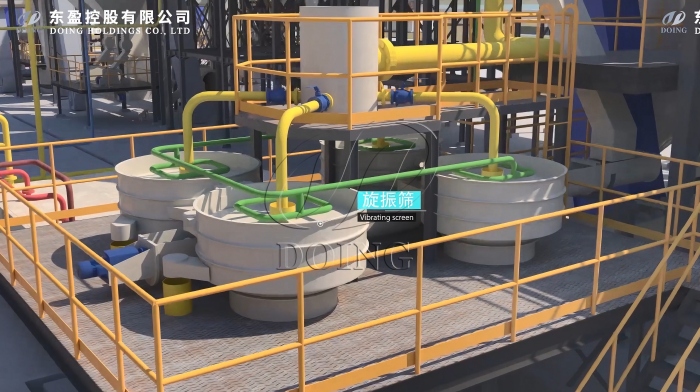 Vibrating screen
2. Core Clarification and Separation Stage
After primary impurity removal, the crude palm oil is heated and stabilized in a crude oil tank, then pumped into a vertical clarification tank—the core separation equipment of this stage. Equipped with steam coils for temperature control, the vertical clarification tank achieves efficient gravity sedimentation and stratification by leveraging the density differences among oil, water, and residue phases.
1) Upper Layer: Pure Oil
Pure palm oil floats to the top and is skimmed off and transferred to the pure oil tank.
2) Middle Layer: Sludge
Sludge and emulsions formed by water, fine solids, and residual oil are sent to the next stage for treatment.
3) Bottom Layer: Heavy Residues
The densest components such as fibers and sediments settle at the conical bottom and are discharged.
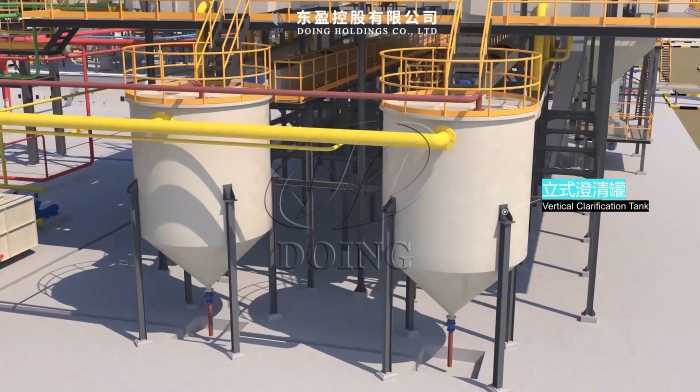 Vertical clarification tank
The pure oil output from the vertical clarification tank is then fed into a vacuum dryer, where residual moisture is removed under vacuum and heating conditions. Once it meets safe storage standards, the oil is pumped to the finished crude palm oil storage tank.
3. Sludge Recovery and Treatment Stage
To maximize oil recovery, the sludge from the middle layer undergoes a closed-loop recovery process.
1) Pretreatment
The sludge passes through a primary oil cyclone (with hot water added) and a desanding tank successively, undergoing cyclonic separation and static sedimentation to remove most sediments.
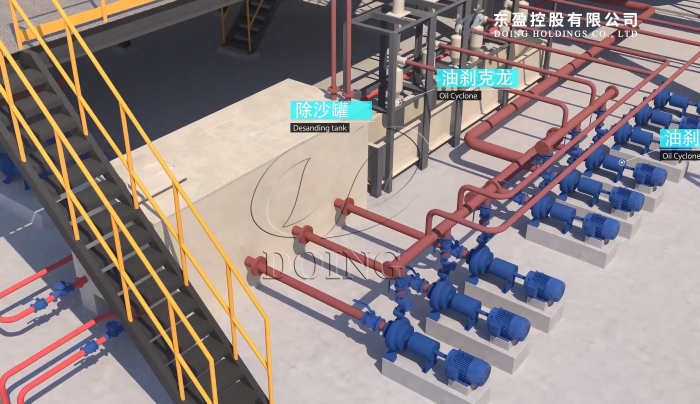 Oil cyclone and desanding tank
2) Core Separation
The pretreated mixture is fed into a three-phase decanter centrifuge, where it is completely separated into three phases (pure oil, wastewater, and sediments) under high centrifugal force.
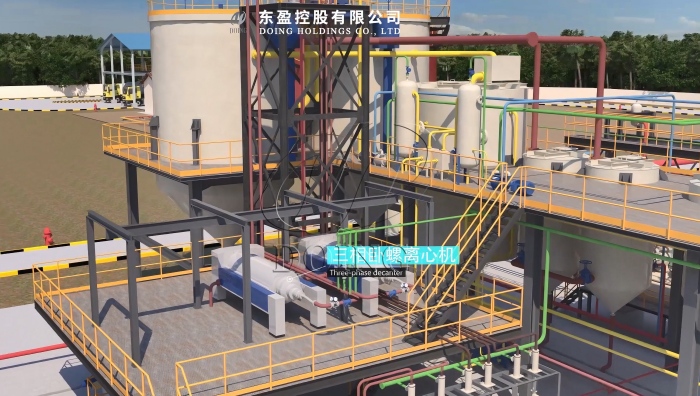 Three-phase decanter
3) Closed-Loop Recovery
The separated purified palm oil is stored following simple filtration and dehydration. The sediments are diluted with water and settled to extract residual oil again. This process significantly improves the overall oil yield of the large-scale palm oil mill.
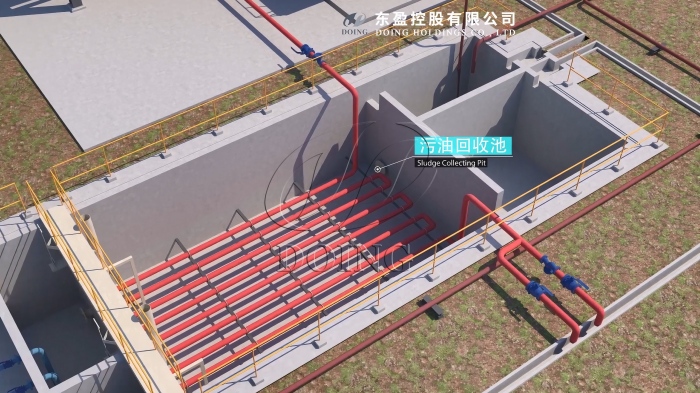 Sludge collecting pit
While producing crude palm oil, the clarification station also implements standardized management of all by-products:
1) Wastewater: Conveyed to the sewage treatment system and discharged or reused after meeting discharge standards.
2) Solid Residues: Combustible solids such as empty fruit bunches, fibers are used as boiler fuel to achieve energy recycling.
In conclusion, the process level of the clarification station in a large palm oil mill is directly related to the quality of your palm oil and production efficiency. If you wish to conduct an efficiency evaluation of your existing clarification process or explore technical upgrading solutions, please feel free to contact Glory Oiltech. Our professional team is ready to provide you with detailed consultations and customized support.


Leave A Message
If you want to know more information about palm oil extraction machine, please kindly leave your phone number. We will get back to you ASAP once we receive your message.