

How Much Palm Fruit Is Needed for 1 Ton of Palm Oil? OER and Processing Equipment
To produce 1 ton of crude palm oil (CPO), a palm oil mill needs approximately 5 tons of fresh fruit bunches (FFB) when the oil extraction rate (OER) is 20%. However, the actual FFB requirement depends on the OER achieved by the mill.
For example, at an OER of 18%, approximately 5.56 tons of FFB are required to produce 1 ton of CPO. At 22%, the requirement decreases to about 4.55 tons.
OER is influenced by both the quality of incoming palm fruit bunches and the efficiency of the entire milling process. Understanding how it is calculated and how fruit quality, operating conditions and equipment configuration affect oil recovery helps palm oil producers estimate production output and select suitable palm oil processing equipment.
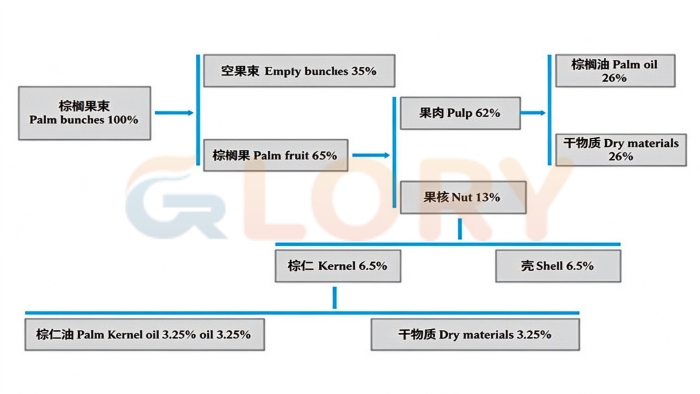 The oil content of palm fruits
1. What Is Palm Oil Extraction Rate (OER)?
Oil extraction rate is the percentage of crude palm oil recovered by a palm oil mill from the fresh fruit bunches it processes. It is an important performance indicator used to evaluate how effectively a mill converts incoming palm fruit bunches into crude palm oil.
According to the Malaysian Palm Oil Board (MPOB), OER represents the weight of oil physically recovered compared with the known weight of FFB processed.
The calculation formula is:
OER (%) = (CPO Recovered / FFB Processed) × 100%
For example, if a palm oil mill processes 100 tons of FFB and recovers 20 tons of CPO, its OER is:
OER = (20 / 100) × 100% = 20%
Three related indicators should be distinguished:
| Indicator | Meaning |
|---|---|
| Oil Content | The amount of oil contained in the fruit or mesocarp before processing. |
| Oil Extraction Rate (OER) | The actual weight of CPO recovered divided by the weight of FFB processed. |
| Residual Oil Rate | The oil remaining in processed materials, such as press fibre, measured for a particular processing stage. |
Oil content and OER are not the same. The mesocarp of a ripe palm fruit can contain a high proportion of oil, but the entire FFB also includes fruitlets, stalks and other non-oil-bearing components. Furthermore, some oil remains in processing residues or is lost during milling.
FAO notes that oil content can reach approximately 50% of mesocarp weight as the fruit approaches maturity. This is a mesocarp-based figure, not the OER of the entire fresh fruit bunch. (FAO, Palm Oil Processing)
Another important distinction is that OER measures crude palm oil, not refined, bleached and deodorized palm oil (RBD Palm Oil). Palm kernel oil is also a separate product obtained from palm kernels and is measured using its own kernel extraction rate (KER).
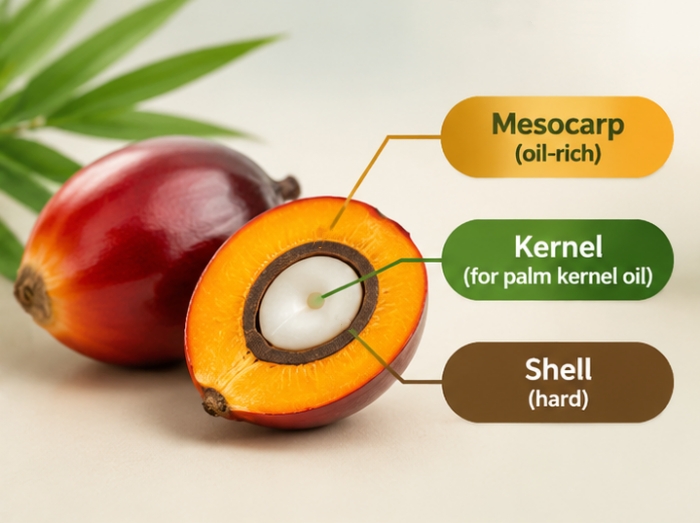 Composition of the palm fruit
2. How Much FFB Is Needed to Produce 1 Ton of CPO?
The amount of FFB required to produce a target quantity of CPO can be calculated directly from the expected OER.
FFB Required (tons) = Target CPO Output (tons) / OER
When using this formula, OER must be expressed as a decimal. For example, 20% should be entered as 0.20.
2.1 FFB Requirements at Different OER Levels
The following table shows how the required FFB quantity changes at different assumed OER levels when the target CPO output is 1 ton.
| Assumed OER | FFB Required for 1 Ton of CPO |
|---|---|
| 18% | 5.56 tons |
| 20% | 5.00 tons |
| 22% | 4.55 tons |
These figures are calculated examples rather than fixed industry performance standards. The actual OER of a palm oil mill depends on the fruit quality and processing conditions.
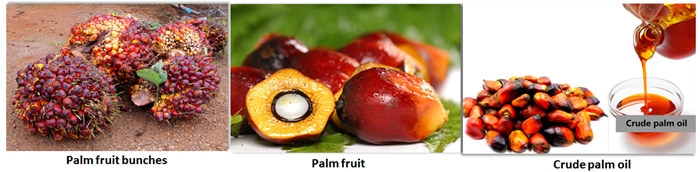 Palm fruit and palm oil
2.2 A Practical Example of Palm Oil Production Calculation
Suppose a palm oil mill receives 5,000 kg of FFB and achieves an OER of 20%.
The expected CPO output is:
CPO Output = 5,000 × 20% = 1,000 kg
Therefore, the mill needs 5 tons of FFB to produce approximately 1 ton of CPO under this assumed operating condition.
The same calculation can be applied to larger projects. For example, if an investor plans to produce 10 tons of CPO per day at an assumed OER of 20%, the required daily FFB supply would be:
10 / 20% = 50 tons of FFB per day
If the mill operates for 10 hours daily, the required processing capacity is:
50 / 10 = 5 tons of FFB per hour (5 TPH)
This calculation provides a starting point for selecting the processing capacity of a palm oil mill.
3. What Factors Affect OER in a Palm Oil Mill?
OER is not determined by the oil content of palm fruits alone. It is influenced by two major areas: the quality of incoming FFB and the efficiency of the milling process.
3.1 FFB Quality and Harvesting Conditions
The quality and composition of FFB directly affect the amount of oil available for extraction.
Several factors are particularly important:
Palm Variety: Different planting materials and fruit characteristics result in different oil-bearing potential. The fruit composition and mesocarp-to-nut ratio influence the amount of oil available for recovery.
Fruit Maturity: Properly matured bunches generally provide better oil-bearing potential than underripe bunches. Harvesting standards therefore influence the amount of recoverable oil entering the mill.
Loose Fruit Collection: Loose fruits contain valuable oil. If they are left in the plantation or lost during transportation and handling, the mill receives less recoverable oil relative to the harvested crop.
Harvesting Practices: Harvesting intervals, bunch selection and the supervision of harvesters affect the quality and composition of incoming FFB.
Transportation and Handling: Poor handling can damage fruits and accelerate deterioration, affecting the quality of the crude palm oil and the efficiency of subsequent processing.
MPOB identifies planting materials, bunch composition, equipment condition, fruit ripeness, loose-fruit collection, harvesting supervision and seasonal conditions as important factors affecting OER. (MPOB, An Economic Perspective of Oil Extraction Rate in the Oil Palm Industry of Malaysia)
 Crude palm oil
3.2 Milling Process and Operating Conditions
Even when a mill receives good-quality FFB, inefficient processing can reduce the amount of oil recovered.
The main processing stages include sterilization, threshing, digestion, pressing, clarification and oil drying. Each stage has a different function, but they work together to determine the final oil recovery.
Sterilization: Steam treatment inactivates lipase enzymes, helps prevent an increase in free fatty acids (FFA), softens the fruit and makes it easier to separate fruitlets from the bunch.
Threshing: Incomplete fruit separation leaves fruitlets attached to empty fruit bunches (EFB), resulting in the loss of recoverable oil.
Digestion: Insufficient heating or mechanical agitation may leave oil-bearing cells incompletely ruptured, making it more difficult to release the oil during pressing.
Pressing: Inappropriate feeding conditions, worn pressing components or unsuitable operating pressure can affect oil extraction and leave more oil in the pressed fibre.
Clarification: Oil carried away with fibre, sludge and wastewater reduces the quantity of CPO ultimately recovered.
According to FAO, sterilization, threshing, digestion and pressing are closely connected operations. In particular, digestion helps break down oil-bearing cells, while screw pressing provides additional mechanical kneading that releases oil from the fruit mash. (FAO, Palm Oil Processing)
4. Which Equipment Helps Improve Oil Recovery in a Palm Oil Mill?
A well-matched palm oil processing line helps ensure that each processing stage operates effectively and that oil losses are controlled throughout the production process.
Glory Oiltech (Henan Glory) provides palm oil processing equipment and integrated production line solutions covering FFB reception, sterilization, threshing, digestion, pressing, clarification, filtration and oil drying.
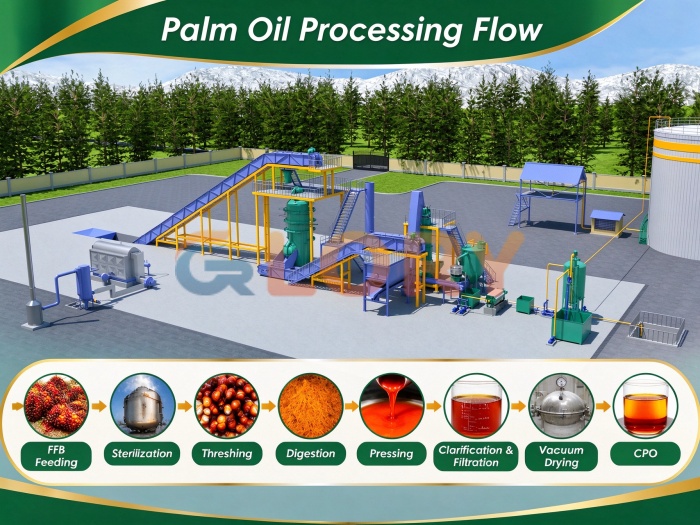 Palm oil processing flow
The following equipment plays an important role in the oil extraction process.
4.1 Palm Fruit Sterilizer
The sterilizer uses steam to treat FFB before threshing. This process helps inactivate lipase enzymes, soften the fruit bunches and improve fruit separation.
The automatic vertical steam sterilizer features:
Maximum sterilization temperature: 145°C
Sterilization time: 60–90 minutes
Heating method: Direct boiler steam supply combined with external heating coils
Automatic feeding and hydraulic discharge doors
Intelligent temperature and time control
Consistent sterilization helps prepare FFB for the subsequent threshing and digestion stages.
4.2 Palm Fruit Thresher
The drum-type palm fruit thresher separates sterilized fruitlets from the empty fruit bunches.
Its rotating drum generates mechanical impact and friction to detach the fruitlets, allowing them to fall through the drum openings while EFB is discharged separately.
The equipment offers:
Processing capacity: 1–15 tons of FFB per hour
Threshing rate: Above 95%
Drum length: Available in 1.5 m and 2 m standard configurations, with larger models up to 5 m
Heavy-duty steel frame and No. 45 carbon steel main shaft
A threshing rate above 95% helps reduce the number of fruits remaining on discharged bunches and improves the utilization of incoming FFB.
4.3 Palm Fruit Digester
After threshing, the fruitlets enter the digester for heating, stirring and mechanical digestion.
The palm fruit digester uses rotating stirring arms to break down the fruit structure and release oil-bearing cells. Heating also reduces oil viscosity and helps prepare the fruit mash for pressing.
The Glory Oiltech palm fruit digester features:
Processing capacity: 1–15 TPH
Digestion temperature: 90–95°C
Stirring speed: Approximately 25–26 RPM
Available horizontal and vertical configurations
A properly operated digester provides more uniform material conditions for the downstream screw press, helping improve oil release and pressing performance.
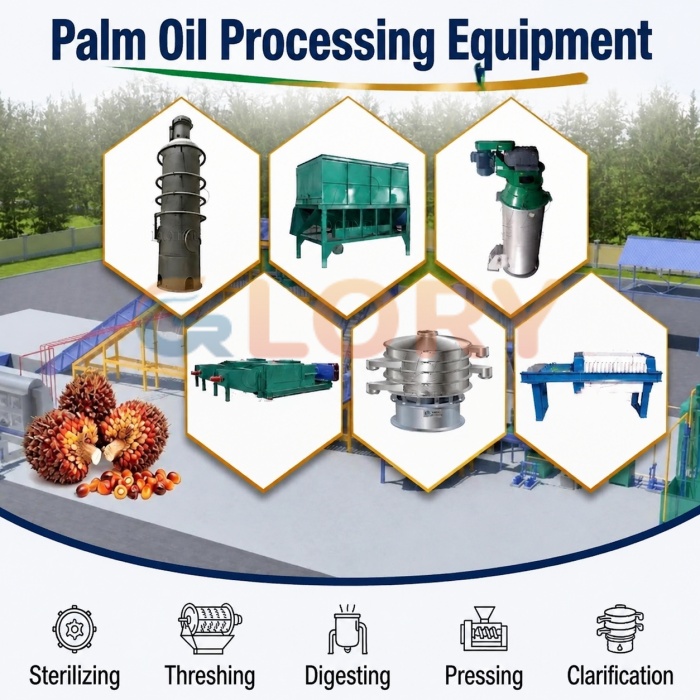 Palm oil processing equipment
4.4 Double Screw Palm Oil Press
The double screw palm oil press is one of the most important machines in the mechanical oil extraction stage.
It uses two intermeshing screw shafts to convey and compress the digested fruit mash. As the material moves through the pressing chamber, the available space decreases and pressure increases, forcing oil through the perforated pressing cage.
The double screw palm oil press is available in multiple capacity configurations, including 1, 5, 10 and 15 TPH models.
For the 1 TPH model, the main specifications include:
Main motor power: 7.5 kW
Hydraulic station power: 2.2 kW
Residual oil rate: 6–7%
Fibre dry-basis oil loss: 6–8%
Hydraulic system pressure: Up to 100 MPa
Pressing screw material: 2Cr13 wear-resistant alloy steel
The residual oil rate and fibre dry-basis oil loss are pressing-stage indicators, not the overall OER of the palm oil mill.
The hydraulic system allows pressing pressure to be adjusted according to operating conditions, while the double-screw structure supports continuous material conveying and compression.
4.5 Palm Oil Clarification and Filtration System
The oil discharged from the screw press contains crude palm oil, water, fibre and other suspended impurities. A clarification and filtration system is therefore required to separate the oil and prepare it for further processing.
A typical system includes:
Palm Oil Clarification Tank
Uses gravity settling to separate heavier impurities, such as sand and solid particles, from the crude oil mixture.
Rotary Vibrating Screen
The Glory Oiltech rotary vibrating screen features:
Vibration frequency: 25 Hz
Material: 316L stainless steel
Multi-layer screen configuration
Impurity removal rate: Above 95%
The impurity removal rate refers to the separation of solid impurities, not the overall oil extraction rate.
Plate and Frame Filter
The plate and frame filter provides further solid-liquid separation through pressure filtration.
Its specifications include:
Filtration area: 1–40 m²
Filtration pressure: Up to 0.6 MPa
Filter plate materials: SUS304 or 316L stainless steel options
4.6 Vacuum Drying System
After clarification and filtration, the crude palm oil still contains moisture that needs to be removed before storage.
A vacuum drying system reduces moisture in the oil under vacuum conditions, helping maintain CPO quality and storage stability.
The equipment configuration should be matched with the upstream clarification capacity and the required final oil quality.
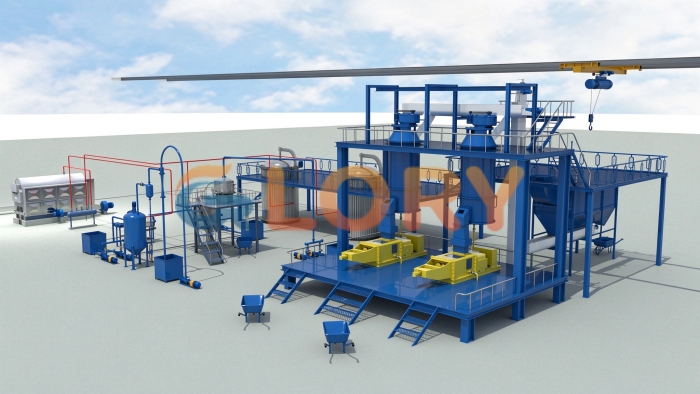 Palm oil processing plant from Glory Oiltech
4.7 Selected Palm Oil Processing Projects
The following projects demonstrate Glory Oiltech's experience in supplying palm oil processing solutions for different capacities and markets.
| Project | Country | Project Status |
|---|---|---|
| 1 TPH Palm Oil Processing Plant | Indonesia | Pre-assembled free-installation solution. Commissioned in March 2026 and entered trial operation. |
| 2 TPH Palm Oil Mill | Nigeria | Installation, commissioning and operator training completed in May 2025. |
| 5 TPH Fully Automatic Palm Oil Mill | Liberia | Turnkey project installed and commissioned in April 2024, followed by trial operation. |
These projects demonstrate experience in supplying palm oil processing solutions for small-scale and fully automatic mill projects across different markets.
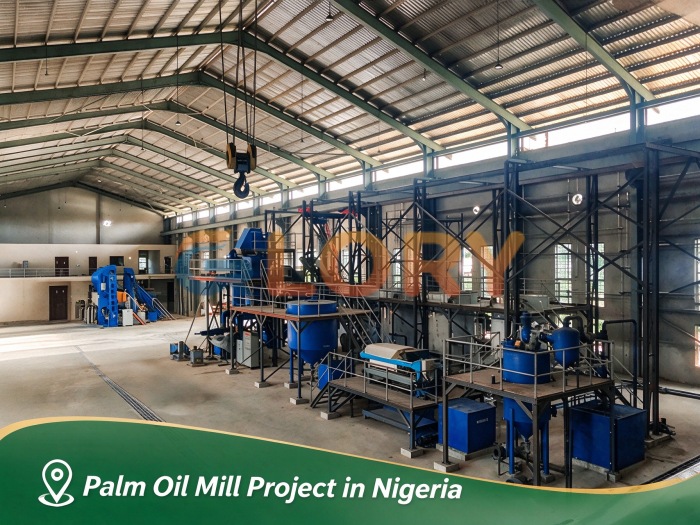 Palm oil mill project in Nigeria
5. How to Choose a Palm Oil Processing Line Based on FFB Supply?
When planning a new palm oil mill, equipment capacity should be selected according to the available FFB supply and the target CPO output.
A practical selection process starts with four basic factors:
Daily FFB Supply: How many tons of fresh fruit bunches can be supplied to the mill each day?
Target CPO Output: How many tons of crude palm oil does the investor plan to produce daily?
Operating Hours: How many hours will the processing line operate each day?
Assumed OER: What OER should be used for the initial production and raw material calculations?
The actual equipment configuration should also consider FFB quality, the local power and steam supply, water availability, factory layout and investment budget.
For different project sizes, the available processing solutions from Glory Oiltech include:
| Project Scale | Processing Line Configuration |
|---|---|
| Small-scale projects | 1–5 TPH Palm Oil Processing Line |
| Medium and large-scale projects | 10–120 TPH Palm Oil Processing Line |
A complete solution may include FFB reception, sterilization, threshing, digestion, pressing, clarification, vacuum drying, kernel recovery, boiler and water treatment systems, depending on the project requirements.
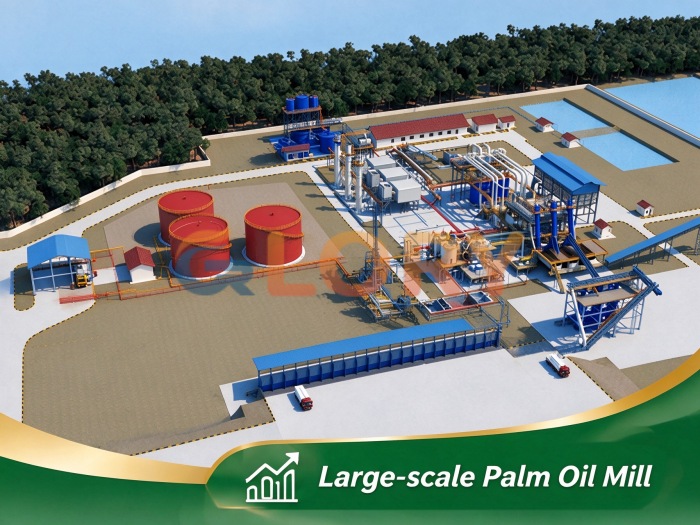 Large scale palm oil mill
Frequently Asked Questions
Is OER the Same as the Oil Content of FFB?
No. Oil content refers to the amount of oil naturally contained in the fruit, while OER measures the CPO actually recovered by the mill relative to the weight of FFB processed. Oil that remains in the fruit or is lost during processing does not contribute to the measured OER.
Can a Palm Oil Screw Press Guarantee a Specific OER?
A screw press alone cannot determine the overall OER of a palm oil mill. The final result also depends on incoming FFB quality, sterilization, threshing, digestion, pressing conditions and oil recovery during clarification. When comparing suppliers, investors should review both machine-level performance indicators and the configuration of the complete processing line.
Does OER Include Oil Extracted from Palm Kernels?
No. OER refers to crude palm oil recovered from fresh fruit bunches, while palm kernel oil is extracted separately from the kernels. These products have different processing routes and extraction indicators. Kernel Extraction Rate (KER) is used to evaluate kernel recovery rather than being included in the CPO OER calculation.
What Is a Good OER for a Palm Oil Mill?
OER varies with fruit quality, mill capacity, equipment configuration and operating conditions. FAO reports that large-scale mills processing good-quality Tenera bunches can achieve extraction rates of approximately 23–24%. This is a contextual industry example, not a universal benchmark or a guaranteed result for every mill.
What Production Records Should a Palm Oil Mill Keep to Monitor OER?
A palm oil mill should maintain records that allow the incoming FFB weight and recovered CPO weight to be compared. Useful records include: daily FFB weighbridge records and supplier information; CPO production and storage tank weighing records; FFB maturity and loose-fruit collection records; unstripped fruit remaining on empty fruit bunches; residual oil in pressed fibre; and processing equipment operating and maintenance records. Regularly reviewing these records helps operators identify changes in production performance and determine which process stages may need adjustment.
Get a Palm Oil Processing Solution Based on Your FFB Supply
Choosing the right palm oil processing line starts with understanding your available raw materials and production targets.
Glory Oiltech can provide a suitable equipment configuration according to your daily FFB supply, target CPO output, operating hours, project location and investment budget.
Whether you are planning a small-scale palm oil mill or a medium-to-large processing plant, a properly matched production line can help improve processing efficiency and support stable long-term operation.
Contact us with your project requirements to discuss a suitable palm oil processing solution.
 PREV:What are the featured advantages of small scale palm oil refining machine?
 NEXT:How many tons palm kernels are needed to produce 1 ton palm kernel oil?
Leave A Message
If you want to know more information about palm oil extraction machine, please kindly leave your phone number. We will get back to you ASAP once we receive your message.