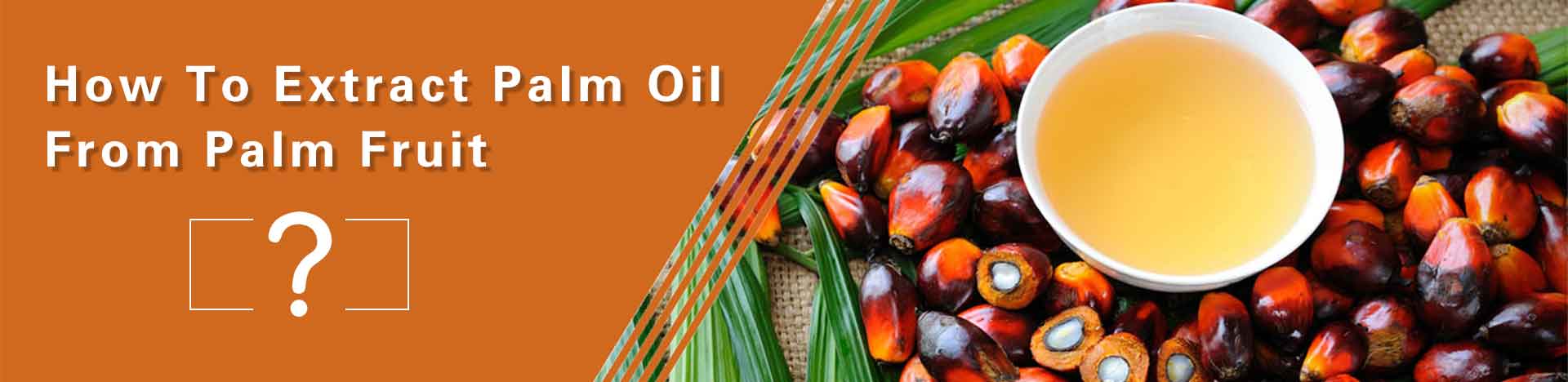

Which Palm Oil Processing Scale Is Right for Your Business? Small-Scale vs. Industrial Mills Compared
Choosing the right palm oil processing scale comes down to one thing: your Fresh Fruit Bunches (FFB) supply. When FFB supply is limited or localized, a small-scale setup is usually the practical fit. When FFB supply is large and steady, a larger industrial-scale mill may be more appropriate.
This guide shows how to determine that scale from your supply, how the two scales compare in practice, and mistakes to avoid when sizing your mill.
1. Determine Your Practical Scale From FFB Supply
Before you settle on a scale, answer three questions:
FFB supply: how much fruit can actually reach the mill from your own plantation, nearby smallholders or contracted farms during both peak and low seasons?
Operating schedule: how many hours per day will you run? This helps determine the hourly processing capacity your FFB supply can support.
Growth outlook: will supply or market grow in the next few years? If yes, plan the expansion path now, not after installation.
Match the scale to the FFB you can realistically secure and process, not to the capacity you hope to grow into.
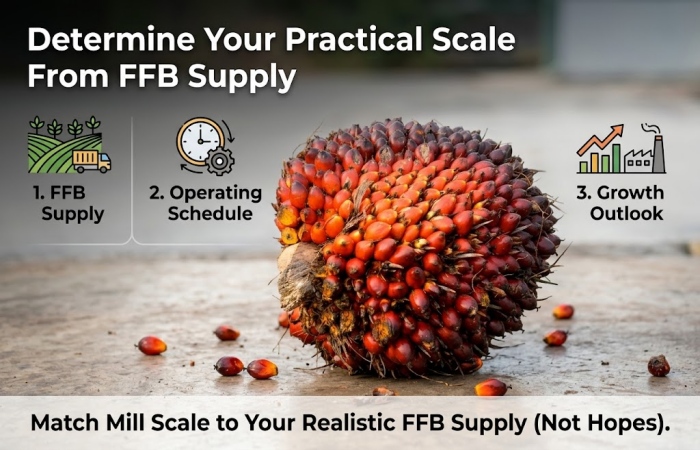 Palm fruit bunch supply chart
2. Compare Small-Scale vs. Industrial Mills
Small-scale and industrial are practical labels, not fixed categories set by a single number. What matters is how the two scales differ in practice, because the differences run far beyond capacity alone:
Table 1: Key Differences Between Small-Scale and Industrial Palm Oil Mills
| Factor | Small-Scale Mill | Industrial Mill |
| Processing capacity | About 0.5–5 TPH* | About 10–120 TPH* |
| FFB supply | Own plantation or nearby smallholders; smaller volumes | Large, steady, well-coordinated supply network |
| Equipment configuration | Compact core line: threshing, pressing, clarification and filtration | Station-based line: FFB reception, sterilization, threshing, digestion and pressing, clarification and vacuum drying, oil storage, kernel recovery |
| Automation | Manual to semi-automatic; fully automatic options available from about 5 TPH | Higher levels of automation and continuous process control can be incorporated |
| Labor | Fewer operators | More staff across processing and support roles |
| Initial investment | Lower | Higher |
| Utilities and infrastructure | Simpler power, water and steam needs | Extensive steam, power, water, storage and conveying systems |
| Oil recovery | Set by FFB quality and process design | Same principle: set by fruit quality and process design |
| Waste and by-products | EFB, fibre and shells can be used for fuel or other applications, depending on the plant design; effluent handling is generally simpler at smaller scale | Larger plants typically require more systematic effluent, by-product and energy management |
| Typical application | Local and small commercial processing | Large commercial and industrial processing |
| Expansion | Depends on the original design; expansion may require additional or upgraded equipment, utilities and space | Can be planned in stages when future capacity growth is part of the project design |
*Note: These ranges reflect Glory Oiltech (Henan Glory)'s published configurations and are provided as practical project references, not as universal industry definitions.
One point the table does not fully show: capacity does not determine oil recovery. Recovery follows FFB maturity and freshness, sterilization, digestion, pressing, clarification and process control. As FAO notes, a mill cannot improve the original quality of the fruit — its role is to prevent or minimize further deterioration during handling and processing. When a supplier quotes a recovery figure, always ask: “Under what FFB quality and operating conditions is this achieved?”
3. Decide Which Scale Fits Your Project
Who Should Choose a Small-Scale Palm Oil Mill?
Choose the small-scale route when supply is limited, the budget is modest and the market is local. This keeps the investment more closely aligned with the amount of FFB the mill can realistically process. It can also be a practical starting point for first-time processors and for growers who plan to expand gradually as their FFB supply grows. Glory Oiltech (Henan Glory) provides small-scale configurations from about 0.5-5 TPH, sized according to the customer's FFB supply and production requirements. When future growth is expected, the initial plant can also be planned with an expansion route in mind. A real example is a 2 TPH small-scale palm oil mill project completed in Nigeria on May 23, 2025, with a line of sterilizer, FFB thresher, digester, double screw press and clarification equipment.
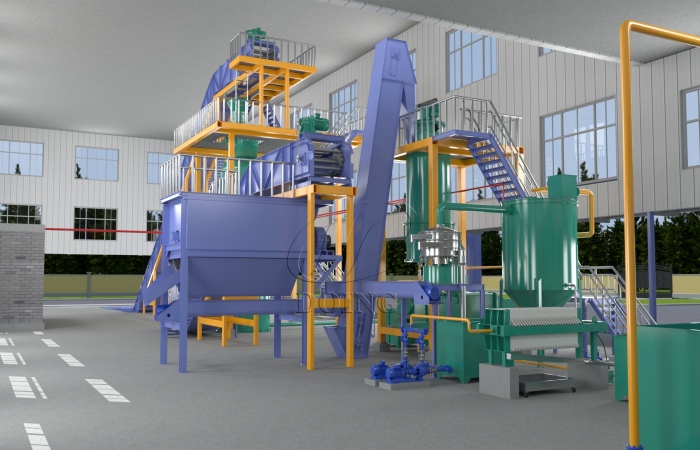 5TPH Palm oil processing equipment solution
Who Should Choose an Industrial-Scale Palm Oil Mill?
Choosing an industrial palm oil mill is a supply-chain decision, not an equipment preference. It fits operators with a large and reliable FFB supply network, a market that can absorb continuous output, and secured land, power, water and capital. Glory Oiltech (Henan Glory) supplies industrial configurations from 10-120 TPH, depending on the project's FFB supply, infrastructure and production requirements.
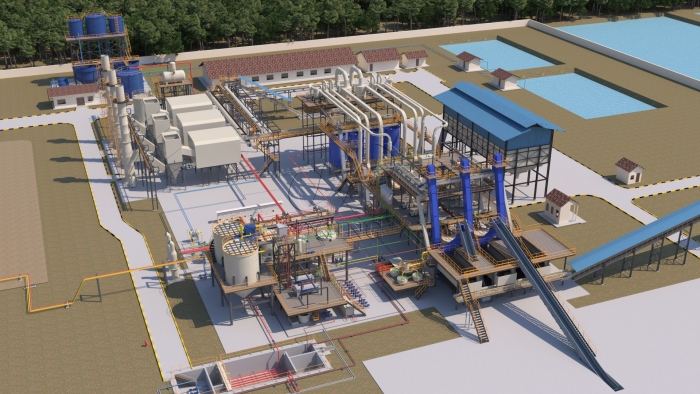 Configuration plan for large-scale industrial palm oil processing equipment
Before you commit to a specific palm oil mill size, confirm these five points — they apply regardless of whether you ultimately choose small-scale or industrial:
Table 2: 5 Questions to Answer Before You Choose a Mill Size
| Step | What to confirm | Why it matters |
| 1 | Year-round FFB supply, not just peak-season volume | Prevents sizing for harvest peaks that leave the mill idle in the low season |
| 2 | Required throughput from your supply and operating schedule | Turns FFB supply into the hourly capacity (TPH) a supplier can quote against |
| 3 | Realistic total project budget | Equipment price is only part of the cost; buildings, utilities and installation scale with the plant |
| 4 | Site and infrastructure readiness | Land, power, water, storage and road access decide what is feasible on your site |
| 5 | Growth plan and expansion route | Designing for extension now is far cheaper than retrofitting later |
Two sizing mistakes to avoid:
Do not size around peak-season FFB alone. If the mill is designed for the highest volume achievable only during a short harvest window, part of the capacity will sit idle for much of the year — yet fixed costs continue regardless of utilization.
Do not compare equipment price alone. Buildings, utilities, storage, material handling, installation and waste management can add significantly to the project total. Site conditions — land title, grid power reliability, water access and road condition — may also constrain what is practical at a particular location. The best starting point is not the largest capacity you can purchase; it is the processing scale your current project conditions can support, with a credible path for future growth.
Need Help Choosing the Right Palm Oil Processing Scale?
If you are still deciding what size of palm oil mill fits your project, you do not need to determine the capacity on your own first.
Start with three basic details: your project location, your FFB source and the amount of FFB you expect to secure. These provide a practical basis for evaluating the appropriate processing scale and equipment configuration.
Glory Oiltech (Henan Glory) works with palm oil processing projects ranging from smaller configurations to larger industrial-scale plants. The appropriate capacity and configuration depend on the project’s FFB supply, site conditions, production requirements and future development plans.
Once these project conditions are clear, the appropriate processing scale and equipment configuration can be evaluated around what your business can realistically support.
If I plan to expand from a small-scale mill later, what should be reserved in the initial design?
Discuss the expansion route with your supplier before finalizing the initial design. Not every plant is built with extension in mind, and retrofitting a working mill is significantly more disruptive than designing for it upfront. At minimum, confirm that the following are addressed in the original layout:
(1) Site footprint and structural clearance: ground floor space, ceiling height and column spacing should accommodate larger equipment or additional process stages
(2) Foundation and structural loading: bases for future presses, clarifiers or digesters may require deeper or wider footings installed from the start
(3) Boiler and steam system capacity: a boiler sized for today’s throughput may need to be oversized or a second unit pre-plumbed if future expansion is planned
(4) Electrical transformer and panel capacity: motor count and power draw will increase with additional equipment; panel headroom avoids a full electrical overhaul later
(5) FFB reception and conveying system: fruit reception pit, ramp and conveyors should be designed to handle the target expanded throughput, not just today’s volume
(6) Storage tanks: crude oil and kernel storage should be sized for the next stage of output, not just current production
Some equipment — such as conveyors, clarification tanks and auxiliary systems — may be reused or upgraded during expansion. Others — notably foundations and boiler sizing — are costly to modify after installation.
How do I calculate the labor needed for a palm oil mill?
There is no universal headcount that fits every project. Labor requirements depend on the processing scale, level of automation, material handling layout and operating schedule. A more useful approach than asking “how many workers” is to map each process stage against the following questions:
(1) Which stages require a dedicated operator during each shift?
(2) Which tasks can be mechanized or semi-automated with existing equipment?
(3) Which operations — mechanical maintenance, boiler tending, laboratory testing, dispatch — require specialized or supporting personnel?
(4) How many shifts will the mill run per day, and does staffing cover each shift or rely on overtime?
Once these questions are answered for a specific plant layout, the labor plan becomes concrete and can be checked against your local wage structure and labor availability.
How soon after harvest should FFB reach the mill?
To be confirmed based on FAO or industry technical guidance: FFB should generally reach the mill within 24-48 hours of harvest to minimize FFA rise.
Is a higher-capacity palm oil mill always more profitable?
Not necessarily. The key question is not capacity but utilization. As a general illustration, a smaller mill operating at around 80% utilization may deliver better returns than a larger mill operating at only 40% if FFB supply is limited — the larger plant still carries its full investment and operating cost regardless of how much fruit it receives.
When comparing plant sizes, look at FFB supply you can realistically secure, expected utilization rate, total project investment and operating costs together. Capacity figures mean little in isolation.


-
 How to start a palm oil milling and processing plant?
-
How to start a palm oil processing business in nigeria?
-
How to produce refined vegetable oil from palm kernel oil?
-
What are the steps in palm oil production?
-
Which Palm Oil Processing Scale Is Right for Your Business? Small-Scale vs. Industrial Mills Compared
-
What Is the Main Role of a Steam Boiler in a Palm Oil Mill?
-
Key Factors to Consider When Setting Up a Palm Oil Processing Plant
-
How Much Does It Cost to Build a 10TPD Palm Oil Refinery Plant?