


How to Improve Palm Oil Extraction Rate: 5 Proven Methods
Palm oil is one of the most widely consumed vegetable oils globally, and for mill operators, every percentage point of extraction rate translates directly into profit. Yet many operators find that a significant portion of oil remains trapped in press cake, fiber, or sludge — money left on the table. The reality is that extraction rate is not determined by a single machine or step. It is the cumulative result of five consecutive process stages, and a weakness in any one stage drags down the entire chain.
Based on our experience at Glory Oiltech (Henan Glory), this article outlines five proven methods — one for each critical stage of palm oil processing — that can help you extract more oil from every ton of fruit. From sterilization to clarification, each method includes specific parameters, equipment recommendations, and real-world project evidence.
The processing chain at a glance:
Sterilization → Threshing → Digesting → Pressing → Clarification
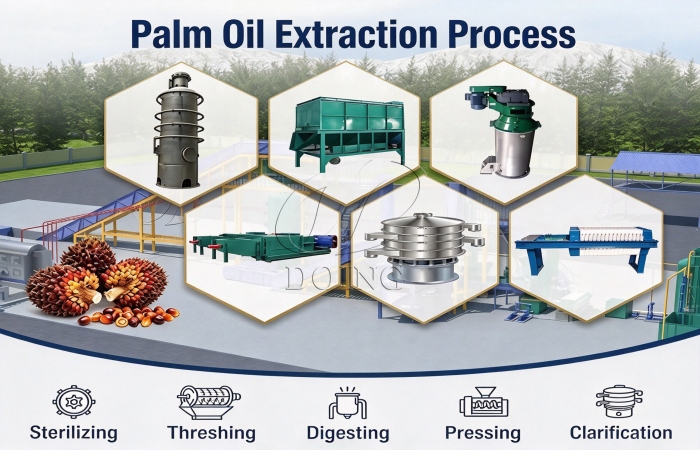 Palm oil extraction
Method 1: Optimize the Sterilization Process
The problem: Under-sterilized palm fruits are hard to thresh, meaning many fruits remain attached to the empty bunches and never enter the extraction chain. Over-sterilization, on the other hand, degrades oil quality and increases free fatty acid (FFA) levels. Both scenarios waste raw material and lower your effective yield.
The solution: Upgrading to a vertical steam sterilizer delivers more uniform heat distribution compared to traditional horizontal models. The vertical design uses peripheral heating coils for even steam circulation, eliminates the need for fruit cages, and supports direct conveyor feeding for fully automated continuous production. This means every fruit bunch receives consistent sterilization — no undercooked cores, no wasted fruit.
Key parameters: The standard sterilization process uses steam at 120–160°C (commonly 145°C) for 60–90 minutes, depending on fruit maturity and equipment design.
A vertical sterilizer also requires up to 70% less floor space than a horizontal unit, making it ideal for mills with limited site area. Glory Oiltech offers palm fruit bunches sterilizers in multiple types, with sterilization cycles as short as 60–90 minutes to improve efficiency.
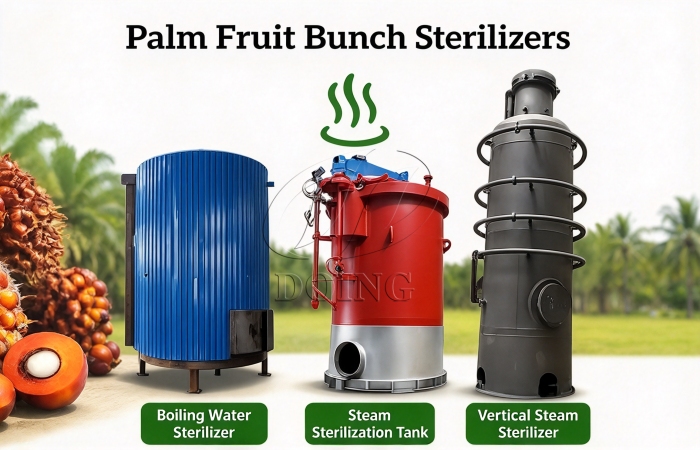 Sterilization tanks
Method 2: Maximize Fruit Threshing Efficiency
The problem: Incomplete fruit separation leaves valuable palm fruits stuck on empty fruit bunches (EFB), which are then discarded or burned as low-value fuel. Manual threshing is labor-intensive and inconsistent, while poorly tuned mechanical threshers can damage fruits or fail to detach them cleanly.
The solution: The drum-type thresher uses a horizontally rotating drum at high speed. Centrifugal force combined with stripping bars forcefully separates fruits from the bunches. Separated fruits fall through the drum grating and are conveyed to the next stage via screw conveyor, while empty bunches are automatically discharged — and can be recycled as boiler biofuel, cutting energy costs.
Key parameters: A drum-type palm fruit thresher can achieve a stripping rate exceeding 95% (with some models reaching 99%), processing 1–15 tons of fruit bunches per hour. The drum diameter exceeds 1.2 meters and can reach lengths of 2.5 meters or more.
For palm oil mills seeking higher throughput, the drum-type thresher provided by Glory Oiltech scales from 1 to 15 TPH with adjustable speed to match different fruit varieties, ensuring maximum fruit recovery with minimal damage.
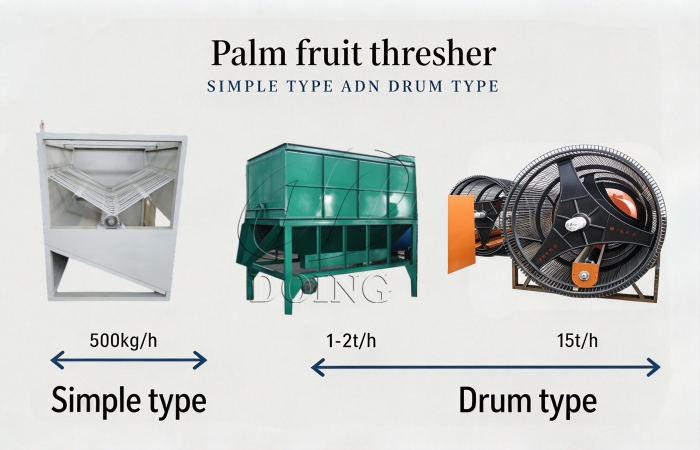 Palm fruit threshers
Method 3: Optimize the Digesting Process
The problem: Digestion bridges threshing and pressing — it thermally conditions and mechanically breaks down sterilized palm fruits into a uniform pulp ready for extraction. Traditional horizontal digesters suffer from short material retention times, incomplete cell rupture, and uneven heating, all of which leave oil trapped inside fruit cells and reduce pressing efficiency.
The solution: A vertical palm fruit digester addresses the shortcomings of horizontal designs by providing longer material retention time, ensuring more complete cell rupture and more thorough heating. The external steam coils maintain precise temperature control, reducing oil viscosity and breaking down pectin to facilitate oil droplet coalescence. The well-digested pulp also reduces wear and pressure on downstream pressing equipment, extending the service life of the entire production line.
Key parameters: Optimal digestion temperature is 90–95°C, with stirring arms rotating at approximately 25–26 RPM to ensure thorough pounding without overheating.
Based on Glory Oiltech's experience, when paired with a double-screw presser, the vertical digester creates a powerful synergy: thorough digestion plus high-pressure extraction equals maximized oil yield.
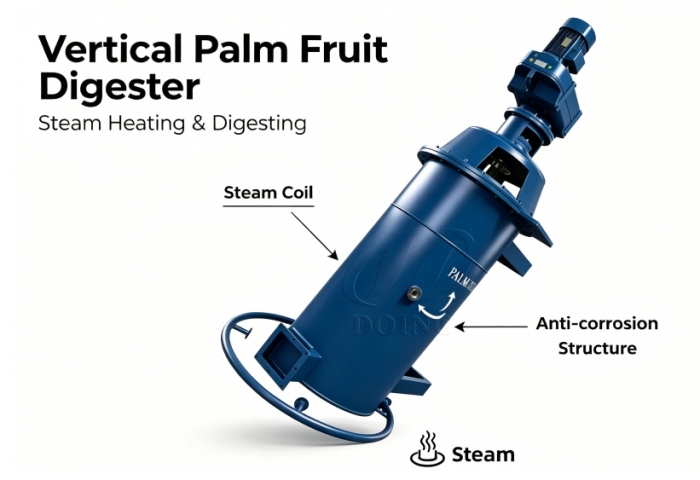 Vertical palm fruit digester
Method 4: Upgrade to Double Screw Pressing Technology
The problem: Single-screw pressers, while suitable for small-scale operations, typically deliver higher residual oil rates in the press cake and have limited hourly capacity. For medium to large mills chasing maximum extraction, this becomes a bottleneck.
The solution: The palm oil presser with double-screw design uses two counter-rotating screws that create a strong, continuous squeezing force — significantly more effective than the single-point pressure of a single-screw model. The screw shafts are made from 2Cr13 wear-resistant alloy steel using an integral casting process, delivering a service life of 6–12 months under normal maintenance, far outlasting standard carbon steel alternatives.
Key parameters: A double-screw palm oil presser achieves a residual oil rate of just 6%–7% in the press cake, with capacities ranging from 1 to 15 tons per hour. The hydraulic system can generate pressures up to 100 MPa with real-time adjustment.
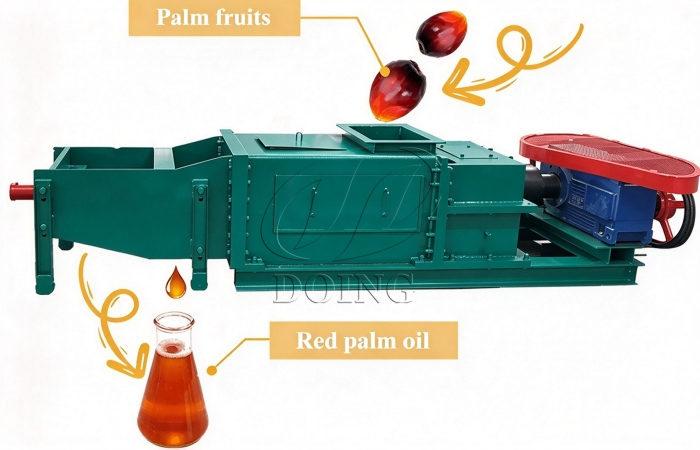 Double screw palm oil presser
Additionally, the double-screw presser keeps palm kernels largely intact during pressing, allowing operators to sell kernels as a separate revenue stream. For mills processing more than 1 TPH, upgrading to a double-screw presser is often the single most impactful equipment change for boosting extraction rate.
Quick comparison:
| Feature | Single Screw Presser | Double Screw Presser |
| Capacity | 300–500 kg/h | 1–15 t/h |
| Pressure Adjustment | Manual | Hydraulic Adjustment |
| Kernel Integrity | Partially crushed | Largely intact |
| Cake Discharge | Prone to blockage | Smooth, no blockage |
| Ideal For | Small workshops | Medium to large mills |
Method 5: Implement Multi-Stage Oil Clarification and Recovery
The problem: Crude palm oil straight from the presser contains solid impurities — sand, fiber, nut shell debris, and plant matter. If not removed efficiently, these impurities accelerate oxidative rancidity, degrade oil quality, and trap usable oil within the sludge. Poor clarification doesn't just hurt quality — it directly reduces the volume of sellable oil.
The solution: The first stage uses a sand settling tank where gravity sedimentation separates heavy impurities like coarse sand and nut shell fragments — the conical bottom design allows easy discharge of accumulated sludge. The second stage employs a rotary vibrating screen (operating at 25 Hz with multi-layer mesh) for coarse filtration, removing pulp fiber and visible debris. The third stage uses a plate-and-frame filter press for fine filtration, trapping colloidal substances and microscopic particles for crystal-clear finished oil.
Key parameters: A three-stage clarification system (sand settling tank → vibrating screen → plate-and-frame filter press) can remove over 95% of impurities, delivering clear, stable crude palm oil.
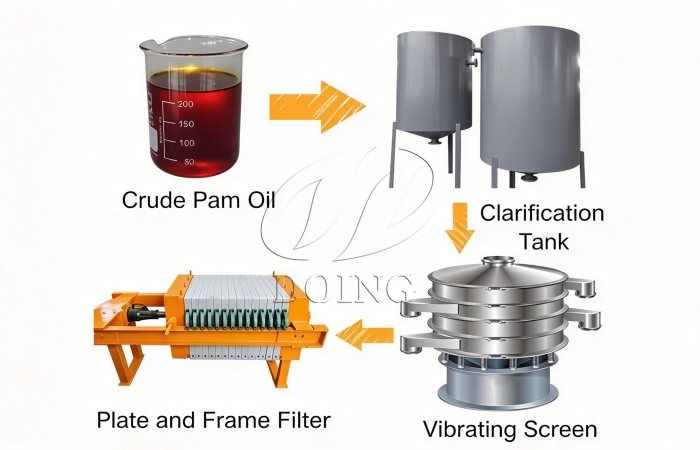 Palm oil clarification machines
All contact surfaces use corrosion-resistant materials, and the system supports fully continuous operation — eliminating the long static sedimentation periods required by traditional methods and dramatically improving both oil recovery and production efficiency.
Real-World Results: Project Case Studies
These five methods are not theoretical — they are the foundation of complete production lines that Glory Oiltech has installed across multiple continents:
•Indonesia (1 TPH): A small-scale mill in Indonesia deployed a pre-assembled 1 TPH palm oil extraction plant featuring a water-boiling sterilizer, drum thresher, digester, double-screw presser, and oil clarification system with vacuum drying, achieving stable operation and full client satisfaction upon commissioning.
•Nigeria (2 TPH): A Nigerian operator deployed a 2 TPH palm oil and palm kernel oil processing line featuring complete equipment supply with factory testing, on-site installation and debugging by Glory engineers, and comprehensive operator training — achieving efficient production and high customer satisfaction.
•Liberia (5 TPH): A Liberian mill deployed a 5 TPH palm oil pressing line featuring a vertical steam sterilization tank, palm fruit thresher, palm oil presser, rotary vibrating screen, sand settling tank, plate-and-frame filter, and vacuum drying system, achieving successful trial operation and stable long-term performance.
FAQ
Q1: Can I upgrade my existing mill without replacing everything?
Yes. The highest ROI upgrades are usually sequential: start with optimizing sterilization parameters, then upgrade the thresher if fruit loss is high, then consider a vertical digester if pressing efficiency is suboptimal. You do not need a full line replacement to see meaningful improvements.
Q2: How does palm kernel quality affect overall oil yield?
Intact kernels are a revenue multiplier. Pressers that crush kernels during extraction not only lose kernel oil but also contaminate the crude palm oil with kernel shell fragments. Choosing a presser design that preserves kernel integrity — such as the double-screw model — protects both your palm oil and palm kernel revenue streams.
Q3: What maintenance practices most impact extraction rate stability?
Regularly inspect screw shaft wear, calibrate sterilization temperature and timing, clean filter screens, and check thresher drum speed settings. A simple monthly maintenance checklist can prevent the gradual yield decline that many operators attribute to "bad fruit batches" when the real cause is equipment wear or parameter drift.
Start Extracting More Palm Oil Today
Improving palm oil extraction rate is a systematic endeavor — no single machine fixes everything, but optimizing each of the five stages (sterilization, threshing, digesting, pressing, clarification) compounds into meaningful gains. Whether you run a 1 TPH workshop or a 15 TPH factory, the right equipment combination and process discipline can lift your yield, reduce waste, and strengthen your bottom line.Glory Oiltech designs and manufactures complete palm oil processing lines backed by 15 years of global project experience. Tell us your expected capacity and budget — our engineers will recommend the optimal configuration to maximize your extraction rate.Contact us today to get a customized optimization plan for your palm oil mill.
 PREV:What Can Replace an Automatic Sterilizer and Boiler in a Small Palm Oil Mill on a Tight Budget?
 NEXT:What Equipment Do You Need for a Small Palm Oil Mill in Cameroon?
Leave A Message
If you want to know more information about palm oil extraction machine, please kindly leave your phone number. We will get back to you ASAP once we receive your message.