


What Is the Best Alternative to a Decanter Centrifuge for Small-Scale Palm Oil Processing?
For small-scale palm oil mills processing only a few tons of fresh fruit bunches (FFB) per day, a decanter centrifuge may not always be the most practical choice. Equipment investment, maintenance requirements, operating complexity, and the actual volume of crude oil to be clarified all influence whether a centrifuge is justified.
For these projects, Glory Oiltech (Henan Glory) recommends evaluating a clarification setup based on a settling tank, vibrating screen, and plate-and-frame filter press before investing in a decanter centrifuge. These machines perform different functions: screening removes coarse fiber, gravity settling separates much of the oil from water and heavier solids, and filtration captures remaining suspended particles. The right combination depends on the required oil quality, available operating resources, and oil recovery targets.
1. Why Consider an Alternative to a Decanter Centrifuge?
A decanter centrifuge separates suspended solids from liquid phases by centrifugal force. It supports continuous processing and can improve oil recovery from certain clarification streams. These advantages must be weighed against the capital investment and operating requirements of a small palm oil mill.
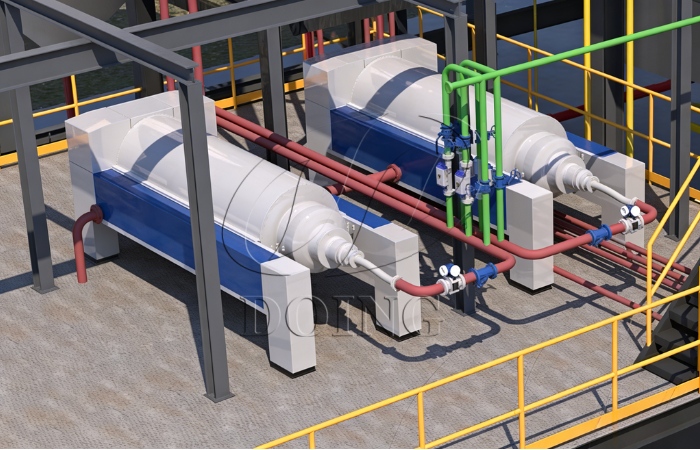 Decanter centrifuge for palm oil clarification
For a small mill processing only a few tons of FFB daily, the practical questions are:
Is the daily crude palm oil volume sufficient to justify a centrifuge?
Can a simpler clarification system meet the required oil cleanliness?
How much labor is available for operating and cleaning the equipment?
Is recovering additional oil from sludge a major business priority?
Would a simpler system be easier to maintain with the available local skills and spare parts?
The decision should be based on the amount of oil to be clarified, the value of oil otherwise lost in sludge, and the total cost of operating each option.
2. Three Practical Alternatives for Small Palm Oil Mills
2.1 Vibrating Screen
A vibrating screen removes coarse fiber and larger suspended particles from the crude palm oil mixture discharged by the screw press. It is commonly used as an early clarification step before settling or other separation processes.
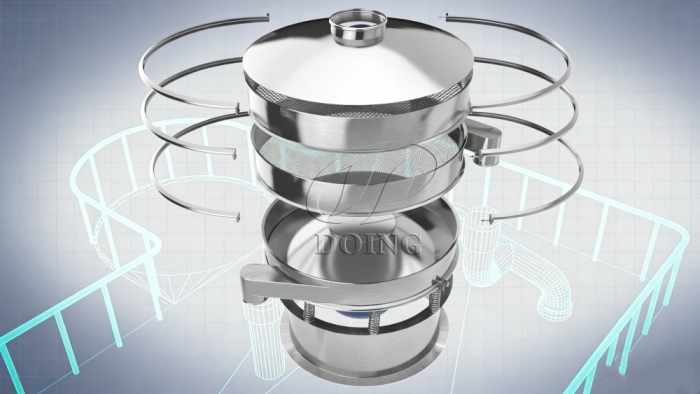 Vibrating screen for palm oil filtration
Glory Oiltech rotary vibrating screen — published specifications:
| Parameter | Specification |
|---|---|
| Stated processing capacity | 560–735 kg/h |
| Reported impurity removal rate | Over 95% |
| Vibration frequency | 25 Hz |
| Screen configuration | Double-layer screen mesh (customizable number of layers) |
| Contact material | 316L stainless steel |
| Screen dimensions | Customizable according to processing requirements |
Advantages
Removes coarse material before it reaches downstream equipment.
Helps reduce the solids load on settling tanks and filters.
Can operate continuously when matched to the process flow.
Limitations
Does not independently separate most of the water from the oil.
Cannot replace a settling tank when gravity separation is required.
Does not remove all fine suspended particles.
Best suited for: Small mills that need to remove fiber and coarse solids before further clarification.
2.2 Gravity Settling Tank
A settling tank separates oil, water, and heavier solids through differences in density. When the crude palm oil mixture is appropriately heated and diluted under suitable process conditions, oil droplets rise while heavier solids settle toward the bottom.
According to AOCS, conventional palm oil clarification can use a temperature of approximately 85–90°C and a settling period of 1–3 hours. At Glory Oiltech, we can design the volume and dimensions of settling tanks based on the feed flow rate and required settling time for a client's palm oil processing project.
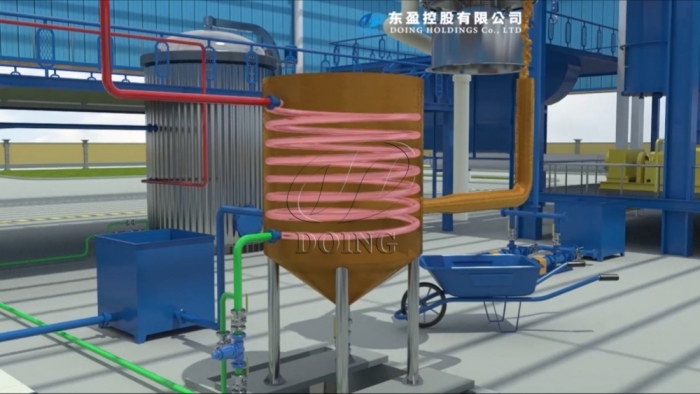 Settling tank for palm oil clarification
Advantages
Relatively simple equipment structure.
No high-speed rotating separation bowl.
Suitable for batch or semi-batch clarification.
Can reduce the need for more complex separation equipment in suitable applications.
Limitations
Requires sufficient settling time and tank capacity.
Fine suspended solids and stable emulsions may not separate completely.
Oil recovery from the bottom sludge may require additional treatment.
Heating, water management, and operator practices affect the result.
Best suited for: Small mills that prioritize simple operation and can accommodate the required settling time and tank space.
2.3 Plate-and-Frame Filter Press
A plate-and-frame filter press separates suspended solid particles from a liquid by passing the mixture through filter media under pressure. In a palm oil clarification system, it can be considered for additional solids removal when the feed condition and filtration arrangement are suitable.
For small mills, a filter press may help improve the cleanliness of the filtered oil. Its performance depends on the incoming oil mixture, solids concentration, filter media, and operating conditions.
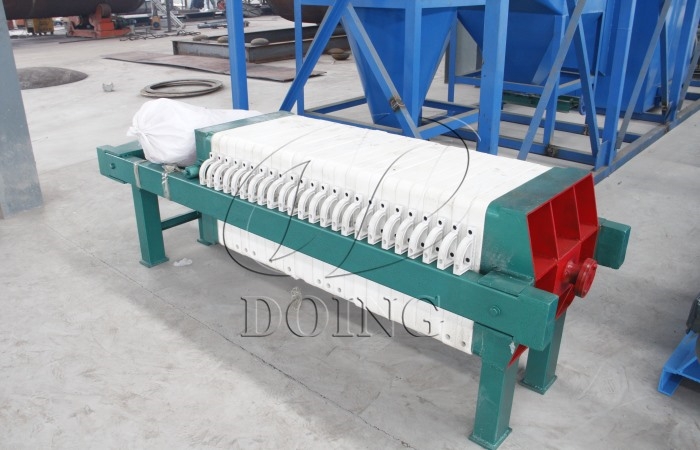 Plate and frame filter press
Glory Oiltech plate-and-frame filter press — product specifications:
| Parameter | Specification |
|---|---|
| Filtration area | 8 m² |
| Rated motor power | 2.2 kW |
| Reference weight | 800 kg |
| Overall dimensions (L × W × H) | 2,630 × 800 × 900 mm |
| Stated processing capacity | 500–1,000 kg/h |
Advantages
Helps capture fine suspended solids.
Provides a defined filtration step after suitable upstream separation.
Can be selected according to the required filtration area and throughput.
Limitations
Filter media require cleaning or replacement.
Fibrous or highly viscous feed may affect filtration performance.
Filtration alone does not guarantee the required moisture content.
Best suited for: Small mills that need an additional filtration stage to reduce residual suspended solids after appropriate screening or settling.
3. Which Clarification Setup Is Best for a Small Palm Oil Mill?
For a palm oil mill processing a few tons of FFB per day, a practical starting point is to evaluate a vibrating screen + gravity settling tank + plate-and-frame filter press configuration.
The sequence matters. Screening removes coarse fiber first, settling separates much of the oil from water and heavier solids, and filtration then targets remaining suspended particles. The exact arrangement should be adapted to the plant's feed characteristics and the condition of the oil after each step.
| Equipment | Main function | What it does not replace |
|---|---|---|
| Vibrating screen | Removes coarse fiber and larger solids | Oil-water separation |
| Settling tank | Separates much of the oil from water and heavier solids | Fine filtration or complete sludge oil recovery |
| Plate-and-frame filter press | Captures suspended solid particles | Complete oil-water separation or final drying |
Glory Oiltech can configure crude palm oil clarification equipment tailored to the specific condition of your crude palm oil. Should your target moisture content or specific process requirements necessitate further dehydration, we can also supply vacuum drying equipment.
4. A Small-Scale Palm Oil Equipment Case in Nigeria
For small palm oil mills processing only a few tons of fresh fruit bunches per day, Glory Oiltech has supplied practical clarification configurations that do not rely on a decanter centrifuge. One such configuration delivered to Nigeria included a palm fruit thresher, a 500 kg/h single-screw palm oil press, a vibrating screen, and a plate-and-frame filter press.
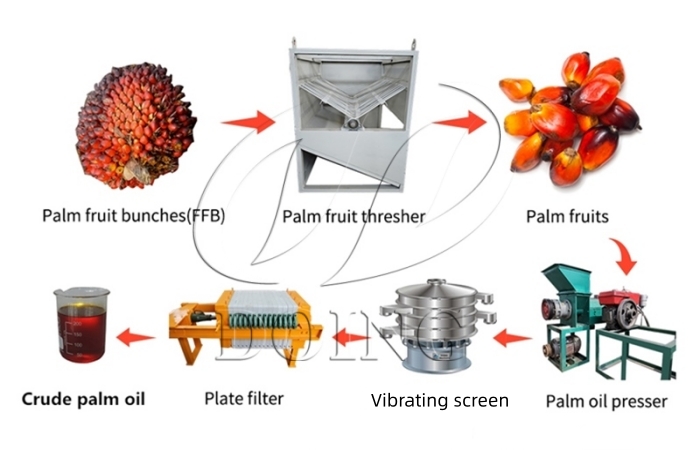 Small scale palm oil processing machine
In this setup, the vibrating screen removes coarse fiber and larger solids from the crude oil mixture discharged by the press. The plate-and-frame filter press then provides an additional filtration stage to reduce remaining suspended particles. Depending on the customer's crude oil condition and moisture target, the line can also be paired with a settling tank and a vacuum drying system.
This palm oil processing project shows how a small mill can achieve acceptable crude palm oil cleanliness through screening, settling, and filtration, without making a decanter centrifuge the default choice.
5. When Is a Decanter Centrifuge Still Worth Considering?
A decanter centrifuge may still be appropriate when a mill requires continuous processing, has a substantial volume of clarification liquor, or places high value on recovering oil from sludge.
According to AOCS, decanters can be used as an alternative to conventional clarification tanks for separating suspended solids. Their suitability depends on the process design and the balance between investment, maintenance, oil recovery, and wastewater handling.
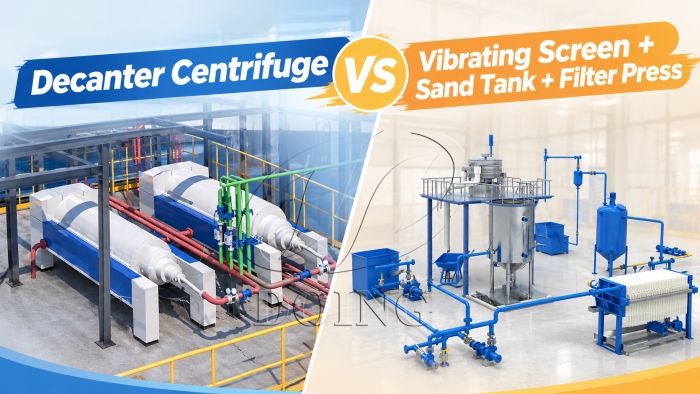 Crude palm oil clarification machine
Before replacing a decanter with a simpler system, assess the following:
Is the main objective to clarify the primary oil stream, or to recover residual oil from sludge?
Can the plant accommodate the settling time and tank volume required?
Would the value of additional oil recovery justify the centrifuge's investment and operating costs?
The best alternative is not necessarily the machine with the lowest purchase price. It is the system that meets the mill’s clarification requirements at an acceptable total operating cost.
Frequently Asked Questions
How can I tell which clarification stage is causing poor oil quality?
Check the oil after each stage. Visible fibers suggest inadequate screening; persistent water or a cloudy oil layer may indicate insufficient separation; fine suspended solids after filtration may point to filter media or operating issues.
When should filter cloths be cleaned or replaced?
Clean the cloths when filtration slows or solids build up. Replace damaged cloths or those that no longer deliver effective filtration after cleaning; follow the filter manufacturer's maintenance guidance.
Does a plate-and-frame filter press remove moisture from crude palm oil?
Not reliably. A filter press mainly removes suspended solids, so check the oil's moisture content separately and add a suitable drying stage if the required specification cannot be met.
What information should I provide before requesting a clarification system quotation?
Provide daily FFB capacity, operating hours, the approximate volume of crude oil to be clarified, available space, and the required oil quality. If possible, share a sample or test results for the crude oil and clarification sludge to support a more accurate equipment recommendation.
Choose Clarification Equipment for Your Actual Processing Needs
For small-scale palm oil mills processing a few tons of FFB per day, a combination of a vibrating screen, settling tank, and plate-and-frame filter press is a practical option to evaluate before investing in a decanter centrifuge.
Glory Oiltech can provide palm oil processing equipment solutions with capacities ranging from 1 to 120 tph, configured around your FFB capacity and clarification requirements.
Contact us today with your daily FFB capacity and target oil quality, and receive a clarification equipment recommendation tailored to your palm oil mill.
 PREV:Setting Up a Palm Kernel Oil Processing Line in Ghana: How to Choose the Right Supplier
 NEXT:1 TPH Palm Oil Pressing Line Daily Output: FFB to CPO Yield Explained
Leave A Message
If you want to know more information about palm oil extraction machine, please kindly leave your phone number. We will get back to you ASAP once we receive your message.

